

Has earnings season repriced the AI trade?


 S&P 500 +1.66% to 7,437.63 US 10-year yield -0.7 basis points to 4.677% Spot gold +0.94% to $4,102.40 an ounce DXY -0.83% to 100.01
What to look out for today
Companies reporting on Friday, 31 July: AbbVie, CBOE Global Markets, Chevron, Colgate-Palmolive, Dominion, Eaton, LyondellBasell Industries, Moderna, T. Rowe Price
Key data to move markets today
EU: French and Italian CPIs, Eurozone Harmonised Index of Consumer Prices and Core Harmonised Index of Consumer Prices and German Unemployment Rate
USA: Employment Cost Index, Chicago PMI, Michigan Consumer Sentiment and Expectations Indices, UoM 1- and 5-year Consumer Inflation Expectations
JAPAN: BoJ Press Conference
Global Macro Updates
US PCE and GDP. June macroeconomic data in the US presented a mixed, but broadly moderating picture. Core PCE rose 0.1% m/o/m in June, undershooting the 0.2% consensus and decelerating from May’s unrevised 0.3% increase. On an annual basis, core PCE held steady at 3.3%, matching expectations and easing slightly from 3.4% previously. Headline PCE declined 0.1% m/o/m, in line with forecasts and reversing May’s 0.5% gain, while the annual rate slowed to 3.7% from 4.1%. Personal spending increased 0.3% m/o/m, meeting expectations,but moderating from an upwardly revised 0.85% in May. Personal income rose a softer 0.2% m/o/m, below both consensus and the prior 0.7% increase.
Growth data pointed to a loss of momentum. The advance estimate of Q2 GDP showed expansion of 1.5%, falling short of the 2.1% consensus and matching Q1’s pace. Notably, inflation within the GDP report re-accelerated, with the price index rising 6.2%, well above expectations, although the core PCE component eased to 3.4% from 4.4%.
The BoE holds. In the UK, the BoE held its policy rate unchanged at 3.75%, with a 6 – 3 vote split that leaned more hawkish than anticipated. MPC member Catherine Mann joined Chief Economist Huw Pill and MPC external member Meghan Greene in voting for a 25 bps hike. While the Monetary Policy Committee reiterated that future decisions will depend on the persistence of inflationary shocks, particularly those linked to geopolitical tensions, it emphasised limited evidence of second-round effects and acknowledged clearer signs of disinflation.
That said, risks remain skewed to the upside. The BoE highlighted potential pressures from AI-driven demand for components and weather-related commodity shocks, alongside uncertainty tied to the Middle East conflict. Updated projections show inflation falling below target by 2028 before converging back to 2% by 2029, with GDP growth forecast at a modest 1.1% through 2027 and unemployment peaking at 5.3%. While markets price roughly a 50% probability of a September hike and close to 40 bps of tightening by year-end, the BoE’s own projections suggest the implied path may already be somewhat restrictive.
The eurozone’s positive growth surprise. In the eurozone, Q2 growth surprised to the upside, with GDP expanding 0.4% q/o/q and 1.0% y/o/y, supported by investment in AI, government spending and temporary factors that offset energy-related headwinds. The core economies - Germany, France and Italy - each grew 0.2% q/o/q, while Spain continued to outperform with a 0.7% q/o/q expansion driven by resilient domestic demand and strong tourism flows.
Despite the stronger-than-expected print, underlying momentum remains modest. Several supporting factors appear temporary, including Ireland’s outsized contribution and possible front-loading of activity. With elevated energy costs still feeding through and geopolitical uncertainty unresolved, growth is expected to soften in Q3, reinforcing expectations of sub-1% expansion for the year.
US Stock Indices
Dow Jones Industrial Average +1.19%
Nasdaq 100 +3.36%
S&P 500 +1.66%, with 6 of the 11 sectors of the S&P 500 up
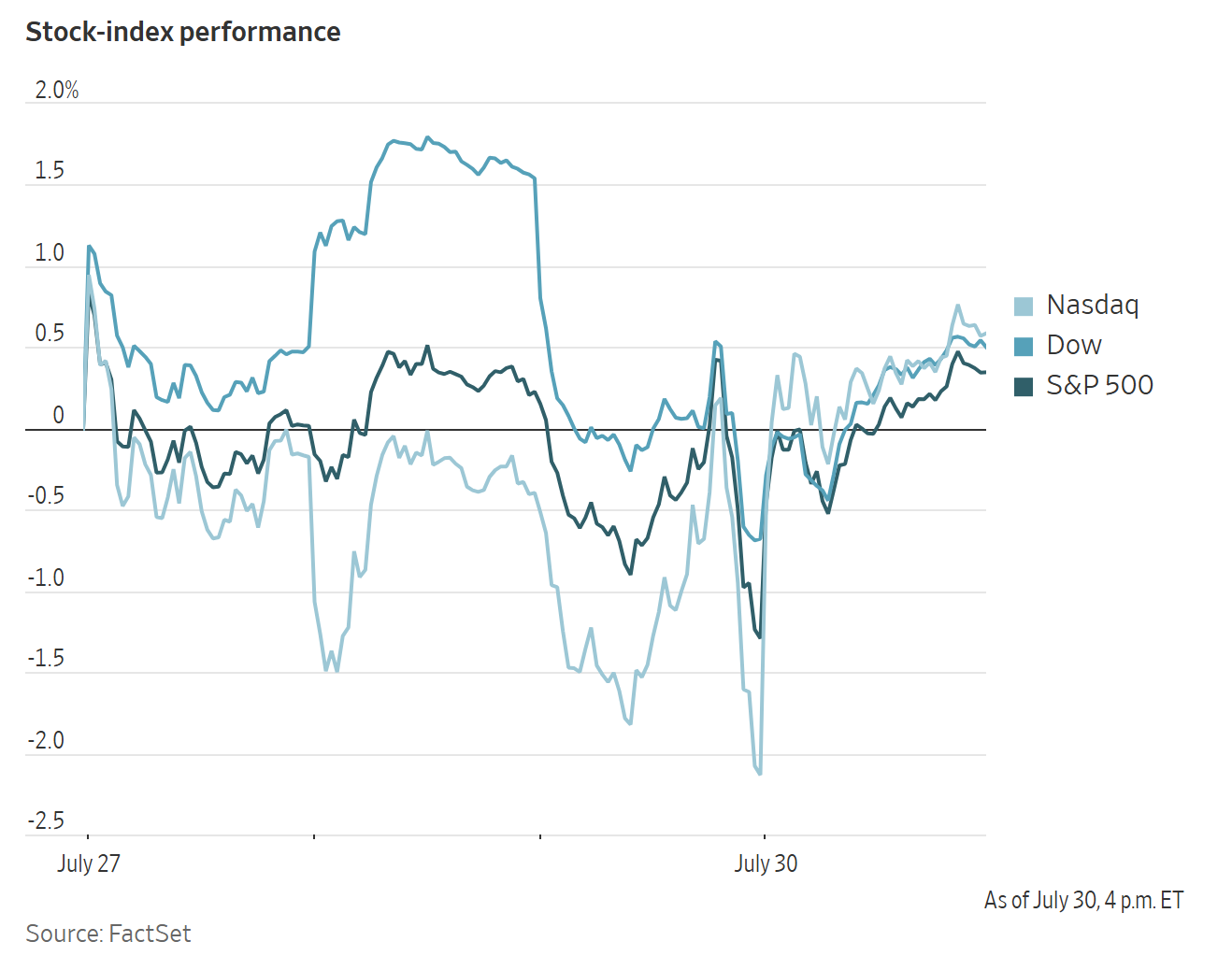
Stocks recovered from the prior session’s sharp losses, helped by a rebound in chipmakers and Microsoft’s strongest daily performance in nearly 20 years.
After Fed Chair Kevin Warsh’s reluctance to raise interest rates triggered a broad selloff in equities and bonds, Microsoft’s upbeat outlook helped restore risk appetite. Major indexes rebounded, led by a +2.78% gain in the Nasdaq Composite. The S&P 500 rose +1.66%, while the Dow Jones Industrial Average advanced +1.19%, or 613.92 points, with Microsoft contributing roughly 360 points.
Amazon Q2 earnings. Amazon's Thursday print completed the AI-capex trilogy after Meta and Microsoft on a distinctly bullish note. Net sales reached $200.606 billion, up 19.6% y/o/y and crossing the $200 billion mark for a single quarter for the first time, comfortably ahead of the $197.035 billion consensus. EPS came in at $5.75 versus a $1.82 Street estimate, though that figure was inflated by a $53.4 billion non-operating pre-tax gain tied to Amazon's stake in Anthropic. Operating income rose 43.2% to $27.461 billion. Net income surged to $62.647 billion from $18.164 billion a year earlier.
AWS stole the show. Cloud revenue reached $42.232 billion, up 36.8% y/o/y, its fastest growth in 18 quarters and well ahead of the 31.3% growth analysts had modeled. AWS operating income reached $16.621 billion, ahead of the $13.624 billion consensus, with AWS operating margin expanding to 39.4%. CEO Andy Jassy noted that ‘AWS is booming... our AI and Chips businesses each eclipsed run rates of more than $25 billion.’ He pointed to Trainium adoption from Anthropic and OpenAI as evidence the custom-silicon bet is paying off. Advertising also contributed to the positive sentiment, increasing 26.2% to $19.809 billion.
CapEx totalled $54.208 billion for the quarter, up 68.4% y/o/y and above the $49.353 billion Street estimate, pushing trailing-twelve-month FCF negative to an outflow of $8.016 billion versus an $18.184 billion inflow a year ago. Despite that, shares jumped in after-hours trading.
The Street’s emerging view is that Amazon has offered the strongest proof so far that AI infrastructure investment is translating into cloud share gains and wider margins, even though AWS growth still lagged Microsoft Azure’s 43% and Google Cloud’s 82% this quarter. Amazon notched its fifth straight quarter of cloud share growth, reinforcing the view that among hyperscalers, CapEx discipline paired with reacceleration is what's earning investor conviction.
Apple Q2 earnings. Apple’s Thursday results closed this week’s megacap earnings cycle on a cautiously negative note. The company beat nearly every major headline metric, but shares still declined after hours, underscoring that, when expectations are this elevated, guidance must do more than simply meet the bar.
Apple reported record June-quarter revenue of $109.417 billion, up 16.4% y/o/y and slightly above the $109.039 billion consensus. EPS reached $2.02, up 28.7% y/o/y and ahead of the $1.89 Street estimate; even excluding an $0.11 benefit from US tariff refunds, EPS still exceeded consensus. iPhone revenue increased 21.7% y/o/y to $54.252 billion, above the $53.742 billion estimate and now accounting for nearly half of total sales. Mac revenue rose 28.7% y/o/y to $10.352 billion, versus the $8.680 billion estimate. Services was the notable soft spot, increasing 12.1% y/o/y to $30.739 billion, below the $31.414 billion analysts expected. Regionally, Greater China revenue grew 22.4% y/o/y to $18.816 billion, broadly in line with the $18.771 billion estimate and signalling long-awaited stabilisation. Gross margin came in at 50.1%, lifted by roughly two percentage points from tariff refunds, though the underlying 48.1% still cleared the midpoint of guidance.
Despite the strong headline results, the stock declined in after-hours trading as investors focused on guidance and supply-chain pressure tied to the global memory-chip shortage, which Tim Cook described as a ‘hundred-year flood’ and that has already led to price increases for Macs and iPads. The move also reflected a sell-the-news reaction after Apple’s strong July performance, its best month in four years, during which the company briefly reached a $5 trillion market capitalisation.
The report can also be viewed as a test of Apple’s position as the market’s AI safety play. Its capital-light approach, centred on licensing AI from Google rather than building hyperscale infrastructure, continues to stand in contrast with capex-heavy peers that face greater scrutiny. The quarter also carried symbolic weight, as it marked Tim Cook’s final earnings call as CEO before handing leadership to John Ternus.
Corporate Earnings Reports
Posted on Thursday, 30 July from The Pulse, our real-time AI-driven news tool. Available exclusively on the EXANTE Web Platform
Amazon reported Q2 2026 revenue of $200.6bn, up +20% y/y and above the $196.4bn consensus. EPS was $5.75, including a $53.4bn unrealised gain on its Anthropic investment. AWS revenue rose +37% y/y to $42.2bn, beating estimates of $40.5bn, with operating margins of 39.4% vs 33.8% expected. The company raised its 2026 cash capex forecast to $220bn, citing higher memory costs. AWS’s AI and chips businesses each surpassed a $25bn annual revenue run rate. Amazon Leo now has nearly 400 satellites, with initial internet service planned this year. Zoox received US regulatory approval to deploy up to 2,500 steering-wheel-free robotaxis annually. CEO Andy Jassy said: “AWS is booming, growing 36.7% year-over-year in Q2—our fastest growth in 18 quarters—and our AI and Chips businesses each eclipsed run rates of more than $25 billion.” For Q3, Amazon guided revenue of $197–202bn, below the $204bn consensus.
Apple reported its Q3 FY26 results. Revenue was $109.4bn, up +16.4% y/y, with EPS of $2.02, beating consensus estimates of $108.9bn and $1.89 respectively. Results included a two-percentage-point benefit from tariff refunds. iPhone revenue was $54.3bn (up +21.7% y/y) and Mac revenue was $10.4bn, both above expectations, while Services revenue of $30.7bn (up +12.1% y/y) and Greater China revenue of $18.8bn missed forecasts. For Q4, Apple guided revenue of $111.7bn-$113.8bn, below consensus of $114.8bn, and gross margins of 47%-48%, including a one-percentage-point tariff-refund benefit. The company declared a dividend of $0.27 per share. CEO Tim Cook described it as Apple's strongest June quarter ever, with double-digit revenue growth across iPhone, Mac and Services, and in every geographic segment.
Mastercard reported Q2 results. Net revenue was $9.3bn (vs $9.08bn expected) and adjusted EPS was $5.04 (vs $4.77 expected). Purchase volume reached $2.42trn (vs $2.40trn expected) and cross-border volumes rose +12% (vs +10.6% expected). The company guided for Q3 operating expense growth of high single digits. The CEO commented that the company delivered above expectations with net revenue growth of 14% y/y, or 12% on a currency-neutral basis.
Bristol-Myers Squibb reported Q2 2026 results that beat expectations. Revenue came in at $12.97bn (+5.7% y/y) vs an estimated $11.74bn, and adjusted EPS was $2.04 vs $1.46 y/y. The company raised its full-year 2026 guidance: revenue now expected around $49.8bn-$50.0bn (previously ~$46.8bn-$47.5bn) and adjusted EPS of $6.75-$7.00 (up from $6.05-$6.35). The adjusted gross margin guidance remained at 69%-70%. The strong performance was driven by newer drugs. The stock also hit a new 52-week high during the period.
Cigna reported Q2 results before the open under a new CEO and business model. Adj EPS was $7.78 (est $7.60, up +8% y/y) and adj revenue was $71.56bn (est $70.34bn, up +7% y/y). FY26 guidance was raised: adj EPS at least $30.45 (est $30.41) and Cigna Healthcare medical care ratio of 83.7%-84.7% (est 83.97%). Segment revenues: Evernorth $61.5bn (+6% y/y) and Cigna Healthcare $11.7bn (+9% y/y). CEO commented that by harnessing technology, data and AI, the company is creating greater value every day.
Coinbase reported Q2 revenue of $1.22bn vs $1.29bn expected, transaction revenue of $599.2mn vs $635.1mn, and subscription & services revenue of $555.1mn vs $594.4mn. Net loss was $(359.5)mn. The exchange achieved a record 10.3% share of global crypto spot volume for the third consecutive quarter, while prediction markets revenue rose +106% q/q and average USDC held hit an all-time high of $20bn. CEO Brian Armstrong said the results proved the 'Everything Exchange' can deliver in all market conditions. Rosenblatt maintained a Buy rating and $240 price target.
European Stock Indices
CAC 40 +0.92%
DAX +0.60%
FTSE 100 -0.10%
Commodities
Gold spot +0.94% to $4,102.40 an ounce
Silver spot +1.54% to $58.62 an ounce
West Texas Intermediate -0.76% to $83.96 a barrel
Brent crude -1.25% to $89.42 a barrel
Gold prices traded less than one percent higher on Thursday. Spot gold increased +0.94% to $4,102.40 per ounce.
Spot silver prices also rose, settling +1.54% higher to $58.62 per ounce
WTI and Brent retreated on Thursday. The Brent September contract expires today, while the October contract settled at $86.88 per barrel.
Brent futures settled at $89.42 per barrel, down $1.13, or -1.25%. WTI futures ended at $83.96 per barrel, down $0.64, or -0.76%.
US forces carried out a two-hour strike on multiple Iranian military targets though the campaign was more restrained than some investors had anticipated following the US President’s Wednesday pledge to hit Iran hard. Updated Kpler shipping data for Wednesday showed 14 commodity vessels passing through the Strait of Hormuz, more than double last week’s levels. Although flows remain below those seen a few weeks ago, before the Houthis announced a blockade of KSA vessels, tankers continue to transit the Bab al-Mandib strait.
Reuters reported yesterday afternoon that the Houthis worked with Iraqi militants in weekend attacks on Saudi Aramco energy facilities, damaging refining and other infrastructure. Shortly before 14:00 EDT, Saudi state media said KSA had established a maritime defence coalition for Red Sea shipping, with 13 other nations participating.
Crude loadings at the CPC Black Sea terminal are offline again following overnight drone attacks. The terminal had only recently reopened after Ukrainian drone strikes a couple of weeks ago curtailed Kazakhstan production by as much as 500,000 bpd.
Month-end tomorrow brings the Petroleum Supply Monthly, while the Brent September, RBOB August and ULSD August contracts also expire.
Russian fuel shortages remain in focus after Russia announced today that it will extend its diesel export ban until 1 September. Kazakhstan’s energy ministry told Reuters that the country is in talks with Russia to process Russian oil at Kazakh refineries, with the resulting products to be sold domestically and a portion supplied back to Russia.
The Russian refinery in Perm, owned by Lukoil and hit overnight by Ukrainian drones on Wednesday, is now said to have shut at least one CDU. It was one of three facilities targeted that night. Another plant hit in Ryazan is expected to remain offline for at least two weeks.
Note: As of 4 pm EDT 30 July 2026
Currencies
EUR +0.58% to $1.1526
GBP +0.79% to $1.3460
Bitcoin +1.42% to $64,690.64
Ethereum +1.11% to $1,917.37
The US dollar index was -0.83% lower on Thursday at 100.01.
The euro traded at $1.1526, up +0.58%, reaching a six-week high. Sterling advanced +0.79% to $1.3460.
The yen strengthened +2.31% to ¥159.63 per US dollar on Thursday. This marked its largest single-day appreciation since January 2023 as Japan conducted yen-buying and US dollar-selling intervention in New York, its first such operation in three months. Later in the day, the BoJ kept the interest rate target unchanged at 1.00%, as expected, after a hike in June.
Japan’s intervention. Nikkei sources said Japan intervened in the FX market while US authorities issued rate checks, pointing to a coordinated move. The scale of the initial yen rally — about five big figures to as high as ¥157.80 per US dollar in less than an hour during the US morning — triggered speculation about a large-scale operation. A subsequent retracement to the ¥159 area early in the afternoon was followed by another move back toward ¥158 after the NY Fed reportedly issued rate checks to multiple banks at the direction of the US Treasury Department, though this remains unconfirmed.
In assessing potential follow-through, investors recalled the 2024 episode that led to intervention, after which the yen appreciated by roughly 20 big figures amid a combination of BoJ rate hikes and disappointing US macro data. CFTC data showed non-commercial short yen positions at 152,125 contracts as of 21 July, close to the 2024 peak of 184,223, underscoring the potential impact of a position shake-out.
Fixed Income
US 10-year Treasury -0.7 basis points to 4.677%
German 10-year Bund -0.1 basis points to 3.182%
UK 10-year Gilt -6.0 basis points to 4.989%
Longer-dated US Treasury yields traded higher on Thursday, extending a move that began after comments from Fed Chair Kevin Warsh on Wednesday unsettled investors, amid concern that FOMC’s family fight would not translate into a stronger resolve to lower inflation.
The yield on the US 10-year Treasury note declined slightly, by -0.7 bps, to 4.677%, after climbing to 4.712% earlier in the session.
The yield on the US 30-year bond increased +1.4 bps to 5.218%, after rising to 5.244% earlier in the session, its highest level since 13 July 2007.
Conversely, the 2-year US Treasury yield, which typically moves in line with Fed interest-rate expectations, fell -2.3 bps to 4.258%.
The US Treasury yield curve, measured by the spread between 2- and 10-year notes, stood at 41.9 bps after earlier climbing to 44.4 bps, its highest level since 29 May.
Eurozone bond yields declined on Thursday as traders reacted to a steeper US 2s10s curve following Wednesday’s FOMC decision.
Germany’s 10-year bond yield declined slightly, by -0.1 bps, to 3.182%. Shorter-dated European bond yields fell further, however, causing curves to steepen. The 2-year Schatz yield declined -3.1 bps to 2.788%.
UK bond yields fell on Thursday after the BoE held interest rates at 3.75%, as expected, and said domestic conditions were likely reducing inflationary pressures. The 10-year UK yield declined -6.0 bps to 4.989%, while the 2-year UK yield fell -12.3 bps to 4.340%.
Note: As of 4 pm EDT 30 July 2026
While every effort has been made to verify the accuracy of this information, EXT Ltd. (hereafter known as “EXANTE”) cannot accept any responsibility or liability for reliance by any person on this publication or any of the information, opinions, or conclusions contained in this publication. The findings and views expressed in this publication do not necessarily reflect the views of EXANTE. Any action taken upon the information contained in this publication is strictly at your own risk. EXANTE will not be liable for any loss or damage in connection with this publication.
Ten artykuł jest publikowany wyłącznie w celach informacyjnych i nie powinien być traktowany jako oferta lub zachęta do kupna lub sprzedaży jakichkolwiek inwestycji lub powiązanych usług, do których można się tu odwołać. Obrót instrumentami finansowymi wiąże się ze znacznym ryzykiem strat i może nie być odpowiedni dla wszystkich inwestorów. Wyniki osiągnięte w przeszłości nie są wiarygodnym wskaźnikiem wyników w przyszłości.




Zarejestruj się i otrzymuj informacje rynkowe
Zarejestruj się i otrzymuj
informacje
rynkowe
Subskrybuj teraz Subskrybuj teraz


Stworzone przez profesjonalistów. Dla profesjonalistów.
