

Is the BoE’s next move higher?


 S&P 500 +1.14% to 7,637.76 US 10-year yield -8.6 basis points to 4.937% Spot gold +1.83% to $4,340.77 an ounce DXY -0.09% at 100.23
Key data to move markets today
EU: German PPI, EcoFin Meeting and Eurogroup Meeting
UK: Retail Sales
USA: Industrial Production and a speech by Fed Governor Michelle Bowman
JAPAN: BoJ Press Conference
Global Macro Updates
BoE leaves Bank Rate unchanged and slows gilt sales programme. The BoE Monetary Policy Committee voted 6 - 3 to keep Bank Rate unchanged at 3.75%, in line with expectations. The MPC noted that inflation had eased since the previous meeting but expected it to rise again, warning that the longer elevated energy prices persist, the greater the risk of second-round effects. All members agreed that risks to energy prices remained skewed to the upside, with inflation projected to stand slightly above four percent in Q1 2027.
The risk of a rate hike appears to have increased, as the BoE indicated that it would not be appropriate to wait too long for evidence of second-round effects, with upside inflation risks now greater than in July. The Bank also described its adverse scenario as a proxy for current conditions. Governor Bailey, Deputy Governor Ramsden, and Deputy Governor Lombardelli warned that policy may need to tighten if the Iran conflict is prolonged, while the majority emphasised that previous tightening in financial conditions should provide time to assess further evidence.
The BoE also slowed its gilt sales programme, outlining a multi-year plan rather than the usual 12-month framework. The Bank said it would reduce holdings at an average annual pace of £46 billion by the end of 2034, combining annual sales of £20 billion with maturing gilts. This pace is slightly below the £50 billion previously expected. In the interim, the BoE will pause gilt sales until it finalises operational details in April 2027.
US Stock Indices
Dow Jones Industrial Average +0.61%
Nasdaq 100 +1.73%
S&P 500 +1.14%, with 9 of the 11 sectors of the S&P 500 up
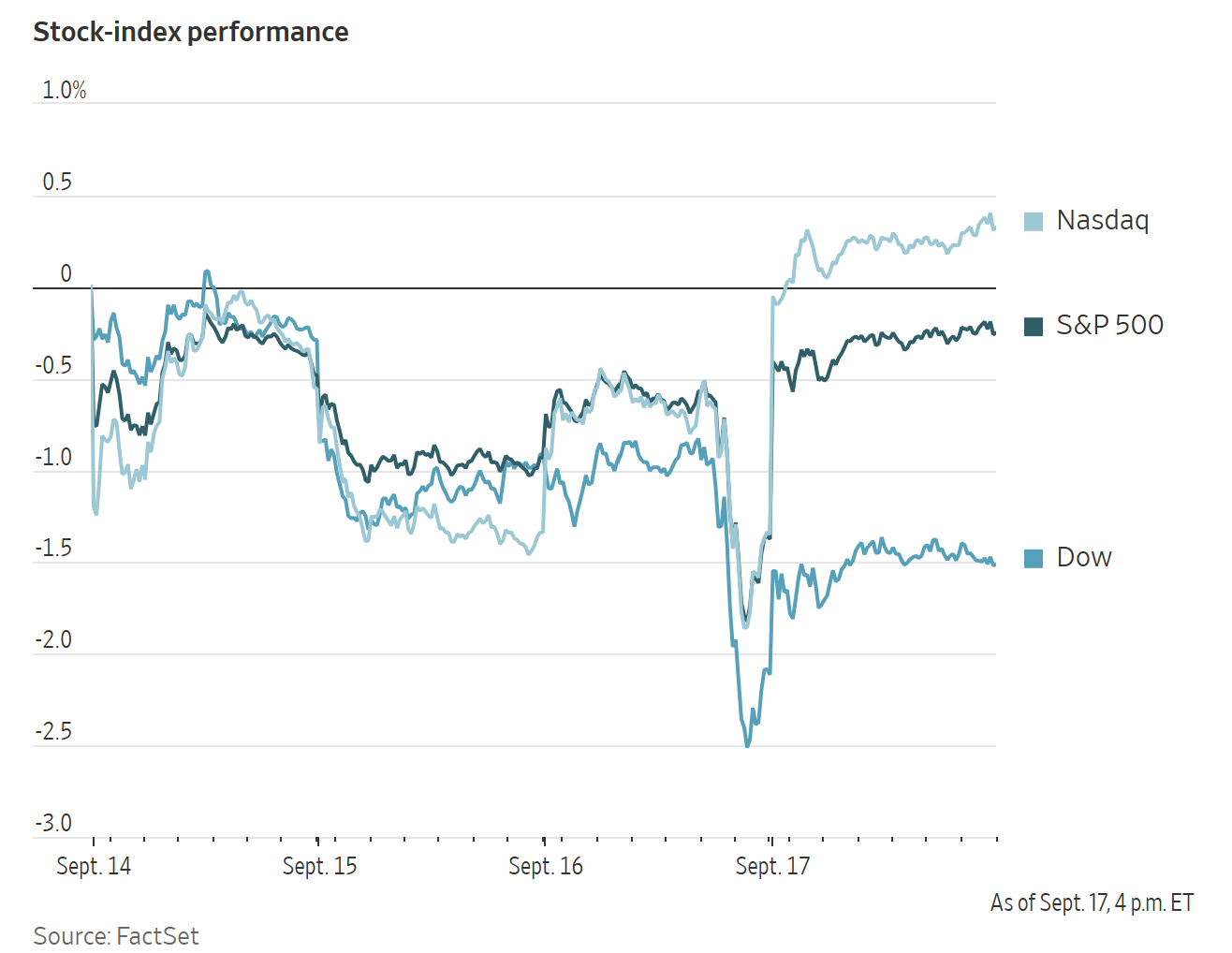
US equities rose on Thursday as investors moved past the volatility that followed the Fed’s first rate hike in three years.
Stocks and bonds had weakened on Wednesday after FOMC officials raised rates by 25 bps and signalled at least one additional hike this year, but those declines were already reversing.
The S&P 500 gained +1.14%, the Nasdaq Composite rose +1.69% and the Dow Jones Industrial Average advanced 316.14 points, or +0.61%, to 51,778.04. Information Technology led S&P 500 sector gains at +2.20%, followed by Consumer Discretionary at +1.43%, while Financials underperformed with a -0.10% decrease.
In corporate news, Generac Holdings closed higher after the backup-power company signed a $2.4 billion agreement to supply data-centre generators to Amazon.
Lennar lowered its full-year home delivery target, citing pressure from higher interest rates and weaker housing-market conditions, as third-quarter revenue and profit declined.
Volvo announced its largest-ever product push, with plans to launch 13 new models by 2030 as it seeks to revive performance. The Swedish automaker aims to double its market share and achieve an operating margin above +8%, with seven new models planned for Western markets and six for China.
The Wall Street Journal reported that ExxonMobil is close to a preliminary agreement to explore investments in several Venezuelan oil fields, nearly two decades after leaving the country. The company could sign a memorandum of understanding with state-run Petróleos de Venezuela as soon as this month to assess investments in developed and undeveloped fields, according to people familiar with the matter.
Diamondback Energy’s largest shareholder sold nearly $2 billion of shares on Tuesday, according to securities filings.
European Stock Indices
CAC 40 +0.57%
DAX +0.70%
FTSE 100 +1.19%
Commodities
Gold spot +1.83% to $4,340.77 an ounce
Silver spot +4.30% to $65.43 an ounce
West Texas Intermediate -1.12% to $101.09 a barrel
Brent crude -1.44% to $104.09 a barrel
Gold advanced by more than one percent on Thursday, recovering from the nearly six-week low reached in the previous session.
Spot gold rose +1.83% to $4,340.77 per ounce.
Spot silver climbed +4.30% to $65.43 per ounce.
Oil prices settled more than one percent lower on Thursday but remained above $100 per barrel, as investors balanced the disruption caused by cross-border strikes involving Saudi Arabia and Yemen’s Iran-backed Houthis against reports that additional Saudi crude could enter global markets and ease supply concerns.
Saudi Arabia and Yemen’s Iran-backed Houthis exchanged fresh strikes across their border on Thursday, raising concerns that the expansion of the Middle East conflict into Yemen and Saudi Arabia could further intensify the global energy supply shortage that has persisted since the United States and Israel attacked Iran in February.
Brent crude futures closed $1.52 lower, or -1.44%, at $104.09 per barrel, while US West Texas Intermediate futures fell $1.15, or -1.12%, to $101.09 per barrel. Both benchmarks had declined by more than two percent on Wednesday.
Earlier in the session, Brent had dropped by more than $3 to its lowest level since 10 September, while WTI also fell by more than $3 to its lowest level since 11 September, after reports indicated that Saudi Arabia was offering additional crude cargoes to Asian refiners through ship-to-ship transfers off Oman’s Sohar port. The extra supply is expected to offset part of the disruption caused by attacks on the East-West pipeline to the Red Sea.
Saudi Arabia was also seeking to restore roughly half of the capacity of its East-West oil pipeline within days after the link was halted last week following drone attacks, Bloomberg news reported.
Oil prices had climbed to nearly four-month highs earlier in the week after shipping industry sources said crude loadings at Saudi Arabia’s Red Sea export hub of Yanbu had been suspended and Riyadh had cancelled some cargo deliveries to European customers. The East-West pipeline supplies Yanbu.
A prolonged closure of the pipeline could remove as much as 4.00% of global oil supply from the market. Saudi Arabia has not specified when operations may resume, although US Energy Secretary Chris Wright told CNBC on Tuesday that crude should be flowing through the pipeline within days.
Three pumping stations serving the East-West pipeline were damaged in last week’s attack, and the repair timeline remained unclear.
Although crude supply disruptions remained the market’s primary concern, tightening diesel supplies also became an additional source of pressure, as disruptions to energy infrastructure in the Middle East and Russia constrained fuel availability.
European gasoil futures, a benchmark for diesel prices, settled at a record high on Tuesday. US ultra-low-sulfur diesel futures also settled at a record high.
A Ukrainian drone attack damaged a refinery in the Russian city of Yaroslavl, causing a fire that was later extinguished, regional Governor Mikhail Yevrayev said on Thursday.
Note: As of 4 pm EDT 17 September 2026
Currencies
EUR +0.10% to $1.1474
GBP -0.15% to $1.3355
Bitcoin +0.58% to $76,373.25
Ethereum +1.76% to $2,446.14
The US dollar eased against the euro on Thursday, one day after posting its largest three-month gain versus the common currency following the Fed’s rate hike and signal of further policy tightening.
The euro rose +0.10% to $1.1474 after falling -0.68% on Wednesday, its largest decline since 17 June.
The US dollar index traded -0.09% lower at 100.23 on Thursday.
Markets remained more hawkish than the Fed. While policymakers projected one additional rate hike in 2026 and no change in 2027, investors were pricing in more than one further increase this year and roughly three additional hikes by the end of 2027.
The shift in market sentiment has been pronounced.
Sterling weakened against the US dollar after the BoE left rates unchanged but cautioned that prolonged conflict in the Middle East could require tighter policy. The British pound traded -0.15% lower at $1.3355.
The British currency has shown limited resilience against the dollar’s recent advance, while the euro was modestly firmer against sterling, likely reflecting some positioning ahead of the BoE meeting.
Sterling was broadly unchanged against the euro at 85.70 pence.
Attention now turns to the BoJ, which raised interest rates to a 31-year high on Friday and signalled its readiness to continue increasing borrowing costs. Market participants are looking for guidance from BoJ Governor Kazuo Ueda’s press conference on the timing and pace of any further increase.
Chief Cabinet Secretary Minoru Kihara, when asked about the Fed’s move, said Japan would continue striving to maintain orderly yen movements through close communication with the United States.
On Thursday, the dollar traded -0.18% lower against the Japanese currency at ¥155.94 yen.
Fixed Income
US 10-year Treasury -8.6 basis points to 4.937%
German 10-year Bund -2.9 basis points to 3.489%
UK 10-year Gilt -8.0 basis points to 5.218%
US Treasury yields moved lower across the curve on Thursday.
The two-year Treasury yield, which typically moves in line with Fed funds rate expectations, ended the session -6.1 bps lower at 4.683%.
The yield on the US 10-year Treasury note declined -8.6 bps to 5.937%, while the 30-year bond yield fell -7.4 bps to 5.291%.
The US 2s10s curve stood at 25.4 bps, narrowing by 2.5 bps from the previous session’s 27.9 bps.
Market expectations for a rate hike at the 28 October FOMC meeting rose to 53.1%, up from 48.7% one day earlier and 27.2% one week earlier, according to CME FedWatch.
Thursday’s 10-year TIPS reopening drew a real yield of 2.653%, the highest real yield for a 10-year TIPS in nearly 18 years. The auction’s bid-to-cover ratio was 2.24x, the lowest for this maturity in one year.
The 2.653% real yield was 22 bps above the result for this TIPS’ originating auction on 23 July and 75 bps above a comparable 10-year reopening auction on 19 March.
Eurozone bond yields traded lower across countries on Thursday, reversing earlier gains.
The BoE left interest rates unchanged, as expected, and outlined a long-term plan to reduce its nearly £500 billion bond portfolio. The plan included a pause in sales until April and a complete halt to sales of long-dated bonds.
UK gilt yields fell sharply following the announcement, while eurozone government bond yields drifted lower.
However, the German curve bear-flattened on Thursday as short-term yields rose. The two-year Schatz yield advanced +1.7 bps to 3.234%.
The yield on the 10-year Bund declined -2.9 bps to 3.489%, after edging higher earlier in the day. It had reached a 17-year peak of 3.572% on Tuesday.
The 30-year Bund yield also declined -2.9 bps to 3.838%.
Markets are pricing in roughly a 40% probability of an ECB rate hike at the October meeting, while three 25 bps increases are fully priced in by June of next year.
Short-dated eurozone government bond yields had climbed earlier in the session, one day after the Fed raised interest rates for the first time in three years and signalled further increases to curb inflation.
Italy’s 10-year BTP yield declined -3.2 bps to 4.343%, leaving the spread over Bunds at 85.4 bps, while France’s 10-year OAT yield declined -2.3 bps to 4.452%.
Note: As of 4 pm EDT 17 September 2026
While every effort has been made to verify the accuracy of this information, EXT Ltd. (hereafter known as “EXANTE”) cannot accept any responsibility or liability for reliance by any person on this publication or any of the information, opinions, or conclusions contained in this publication. The findings and views expressed in this publication do not necessarily reflect the views of EXANTE. Any action taken upon the information contained in this publication is strictly at your own risk. EXANTE will not be liable for any loss or damage in connection with this publication.
Ten artykuł jest publikowany wyłącznie w celach informacyjnych i nie powinien być traktowany jako oferta lub zachęta do kupna lub sprzedaży jakichkolwiek inwestycji lub powiązanych usług, do których można się tu odwołać. Obrót instrumentami finansowymi wiąże się ze znacznym ryzykiem strat i może nie być odpowiedni dla wszystkich inwestorów. Wyniki osiągnięte w przeszłości nie są wiarygodnym wskaźnikiem wyników w przyszłości.
 Wróć do wszystkich informacji



Zarejestruj się i otrzymuj informacje rynkowe
Zarejestruj się i otrzymuj
informacje
rynkowe
Subskrybuj teraz Subskrybuj teraz


Stworzone przez profesjonalistów. Dla profesjonalistów.
