

Will peace change the Fed pivot and AI cycle?


Markets in June
Global equity markets have been broadly mixed in June. Uncertainty around the opening of the Strait of Hormuz and the terms of any peace deal with Iran, aggressive AI investments and increasing questions as to whether we are in an AI bubble about to burst and central bank tightening on rising inflation fears, created a volatile month. The (MTD) performance: S&P 500 -2.93%, Nasdaq 100 -3.67%, Dow Jones Industrial Average +1.24% and the Russell 2000 +2.31%.
Global bond markets saw yields fall this month. The 60-day extension of the ceasefire with Iran has led to lower oil prices, increasing hopes that some central banks may not tighten as much as projected. Over the month, the US yield curve has bear flattened, with the spread between 2 and 10-year yields dropping from 44 bps at the end of May to 25.7 bps MTD. The US dollar index is +2.66% MTD. Gold fell again in June as expectations of higher for longer rate environments remained, making the non-yielding asset less attractive.
The economic picture
USA: US economic data released in June indicates that the US economy is faring very well. The US Bureau for Labor Statistics showed that the US labour market in May 2026 added 172,000 non-farm payroll jobs and the national unemployment rate was 4.3%. Average hourly earnings rose by 0.3%, but are up by 3.4% y/o/y. On the growth front, business activity rose again in June, with the S&P Global Flash US Composite PMI coming in at 52.2, up from May’s 51.5 and a 5-month high. The Flash Services PMI came in at 51.3, up from May’s 50.7, and a 4-month high. The Flash Manufacturing PMI reached a 49-month high, coming in at 55.7 from May’s 55.1. However, the growth was at least partly attributable to demand being temporarily supported by the front-running of potential supply issues and price hikes associated with the war with Iran. Supply chain delays grew more widespread in June. Supplier delivery times lengthened on average to the greatest extent since August 2022 and employment fell for a second month running in June as companies continued to focus on cost reduction amid high input prices and concerns over the outlook. On the consumer side, the preliminary June reading of the University of Michigan Confidence survey rose to 48.9, up from May's record low of 44.8 as lower gasoline prices provided some relief, particularly to lower income consumers. Sentiment is currently 13% below January 2026 and 19% below a year ago, as consumers continue to feel the rise in inflation. Year-ahead inflation expectations edged down from 4.8% in May to 4.6% this month. However, this still exceeds the 3.4% reading seen in February 2026 prior to the start of the Iran conflict. Long-run inflation expectations fell from 3.9% last month to 3.4% in June. CPI rose in line with expectations in May. Annualised inflation rose to 4.2% in May, according to the Bureau for Labor Statistics. This is the highest rate in three years. It rose 0.5% m/o/m. Core inflation rose slightly below the estimate of 0.3%, instead coming in at 0.2% m/o/m, while annualised core inflation came in at 2.9%, in line with expectations.
EU: The eurozone is showing some signs of resilience after a year of weakness. Eurozone headline inflation rose to 3.2% in May 2026, up from 3.0% in April, which prompted the ECB to raise rates by 25 bps at the June meeting. The S&P Eurozone Flash Composite PMI for June rose to 49.5 from 48.5 in May. Although the index remained below the 50 threshold for a third consecutive month, the reading marked a 3-month high and signalled a clear moderation in the pace of decline. The Flash Services PMI was also at a 3-month high, coming in at 48.9, up from May’s 47.7. The Flash Manufacturing PMI slipped to 51.3, down from May’s 51.6 and a 4-month low. Overall, price pressures continued to moderate, as input-cost inflation fell to its weakest level since February and output-price growth eased to a three-month low. Supply-chain strains persisted, but became less severe. Employment recorded its smallest decline since February. Business confidence also improved for a second consecutive month, although it remained subdued by historical standards. Germany, Europe’s largest economy, continued to see its growth decline, with its composite PMI falling to an 18-month low amid weaker services activity.
European consumers are also becoming more confident. According to the European Commission, the flash estimate of the consumer confidence indicator showed an improvement in the EU, +1.2 percentage points compared with May, to -17.7. However, consumer confidence remains well below its long-term average. The ECB’s wage tracker indicates negotiated wage growth with smoothed one-off payments of negotiated wage growth of 3.0% in 2025 and 2.6% in 2026. The headline ECB wage tracker averaged 1.8% in the first quarter, 2.1% in the second quarter and 2.6% in the third and fourth quarters. Although above the ECB’s target rate, wage growth rate of around 3% is considered balanced by the ECB.
UK: The UK economy appears to be coming under increasing strain. Weaker service activity led to a drop in business activity in June. The S&P Global Flash Composite PMI fell to a 14-month low of 49.4, below the 50.5 consensus estimate and the prior reading of 49.7. Services activity declined to a 41-month low of 48.7 from May’s 49.3 reading. Manufacturing was more resilient at 53, but was below May’s 53.9 reading and a three-month low. This was the second consecutive month in which activity contracted, with new business volumes declining at the fastest pace in 14 months and contributing to a sharper fall in backlogs of work. The downturn in services was attributed to domestic political uncertainty and the impact of the Middle East conflict. In manufacturing, expansion continued to rely partly on anecdotal reports of strategic stockpiling, which may fade after providing temporary support. Headline inflation in the UK remained steady in May, matching April’s 2.8% annualised rate. This was largely attributed to lower food costs offsetting price pressures from air fares, vehicle taxes and petrol. However, price growth in the services sector climbed to 3.7%. In addition, core inflation was up in May, rising 2.6% annualised, up from 2.5% in April; the CPI goods annual rate slowed from 2.4% to 2.0%, while the CPI services annual rate rose from 3.2% to 3.7%. According to the Office for National Statistics (ONS) June 2026 release, the unemployment rate is 4.9%. The economic inactivity rate rose by 0.1 percentage points to 21%. The early estimate of payrolled employees for May 2026 decreased by 119,000 (0.4%) on the year, but was largely unchanged on the month, increasing by just 2,000 (0.0%) to 30.3 million. The labour market is becoming increasingly fragile with job vacancies falling 19,000 over the quarter and down 31,000 on an annual basis.
Global market indices
USA:
S&P 500 -2.93% MTD and +7.49% YTD
Nasdaq 100 -3.67% MTD and +15.72% YTD
Dow Jones Industrial Average +1.24% MTD and +7.88% YTD
NYSE Composite +0.86% MTD and +6.77% YTD
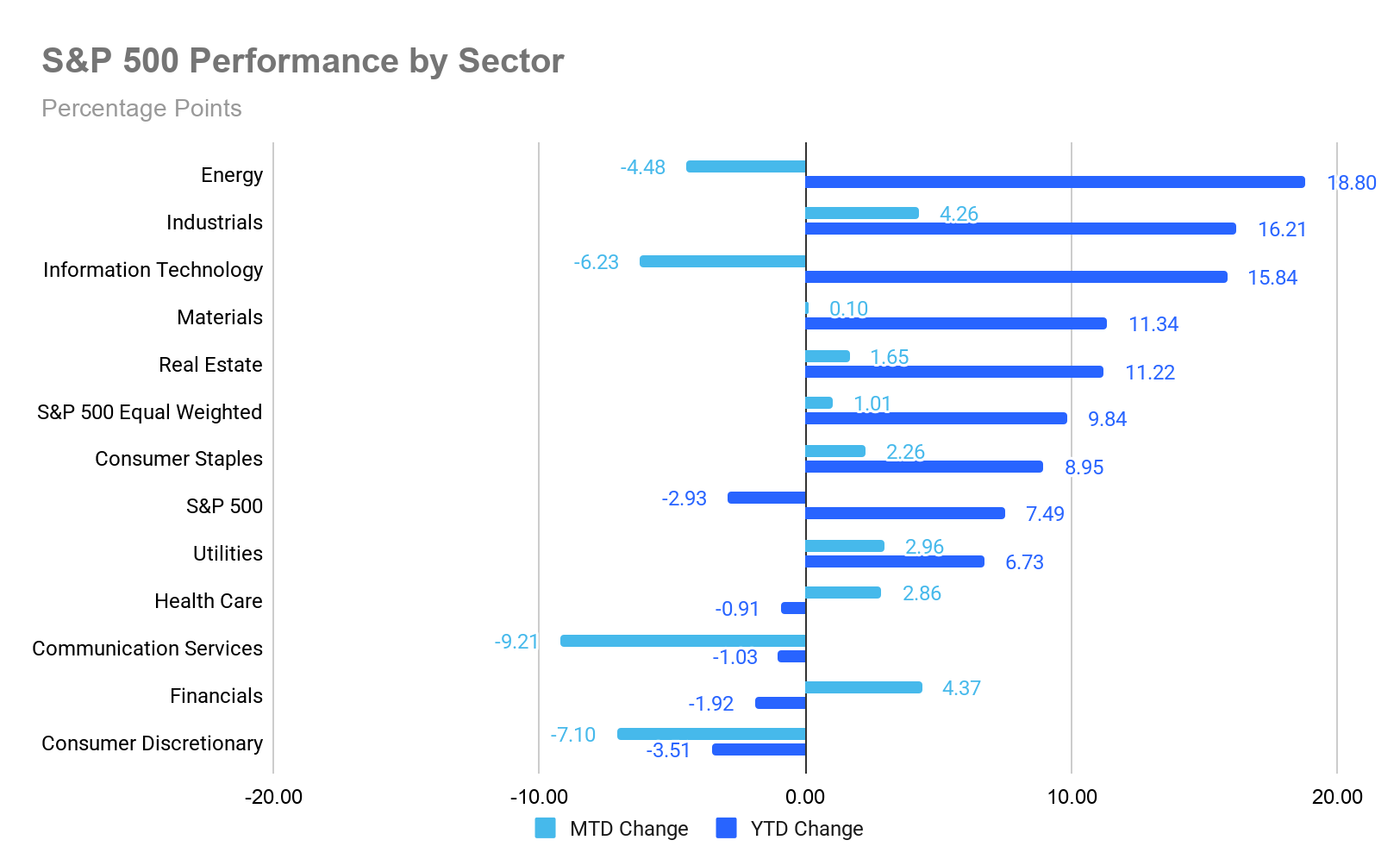
Source: FactSet
The Equally Weighted version of the S&P 500 is +1.01% MTD so far in June, 3.94 percentage points higher than the benchmark.
The S&P 500 Financials sector is the top performer thus far in June at +4.37% MTD and -1.92% YTD, while Communication Services underperformed -9.21% MTD and -1.03% YTD.
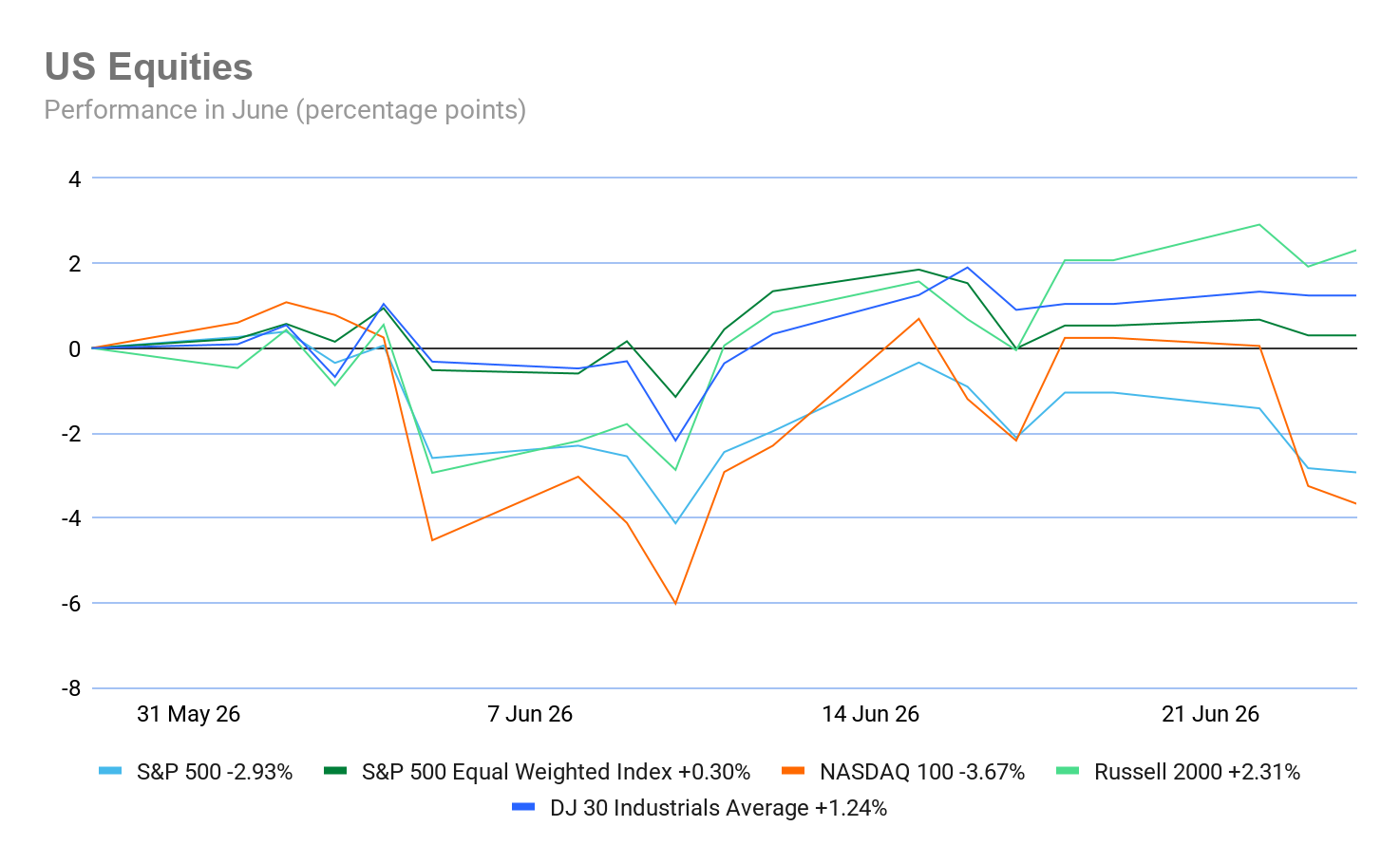
US stock indexes gave back earlier gains, as strength in Industrials and Consumer Discretionary sectors offset weakness in Energy and Information Technology. The Nasdaq Composite fell -0.43% after losing -3.51% over the previous two sessions, while the Dow Industrials rose +0.35% or 182.06 points, after earlier gains of more than one percent. The S&P 500 slipped -0.10%.
Anthropic PBC accused Alibaba Group of using thousands of fraudulent accounts in a broad effort to improperly access its Claude AI model, undermining the US developer’s decision to withhold its products from China.
OpenAI introduced Jalapeño, its first custom AI chip developed with Broadcom, as part of an effort to improve performance by tailoring hardware to its products.
Cerebras Systems fell to its lowest level since going public after the chipmaker issued a weaker-than-expected annual sales forecast.
SK Hynix is seeking 45.45 trillion won ($29.4 billion) through a US listing, aiming to capitalise on demand for memory-chip stocks despite this week’s sharp sector selloff.
Europe:
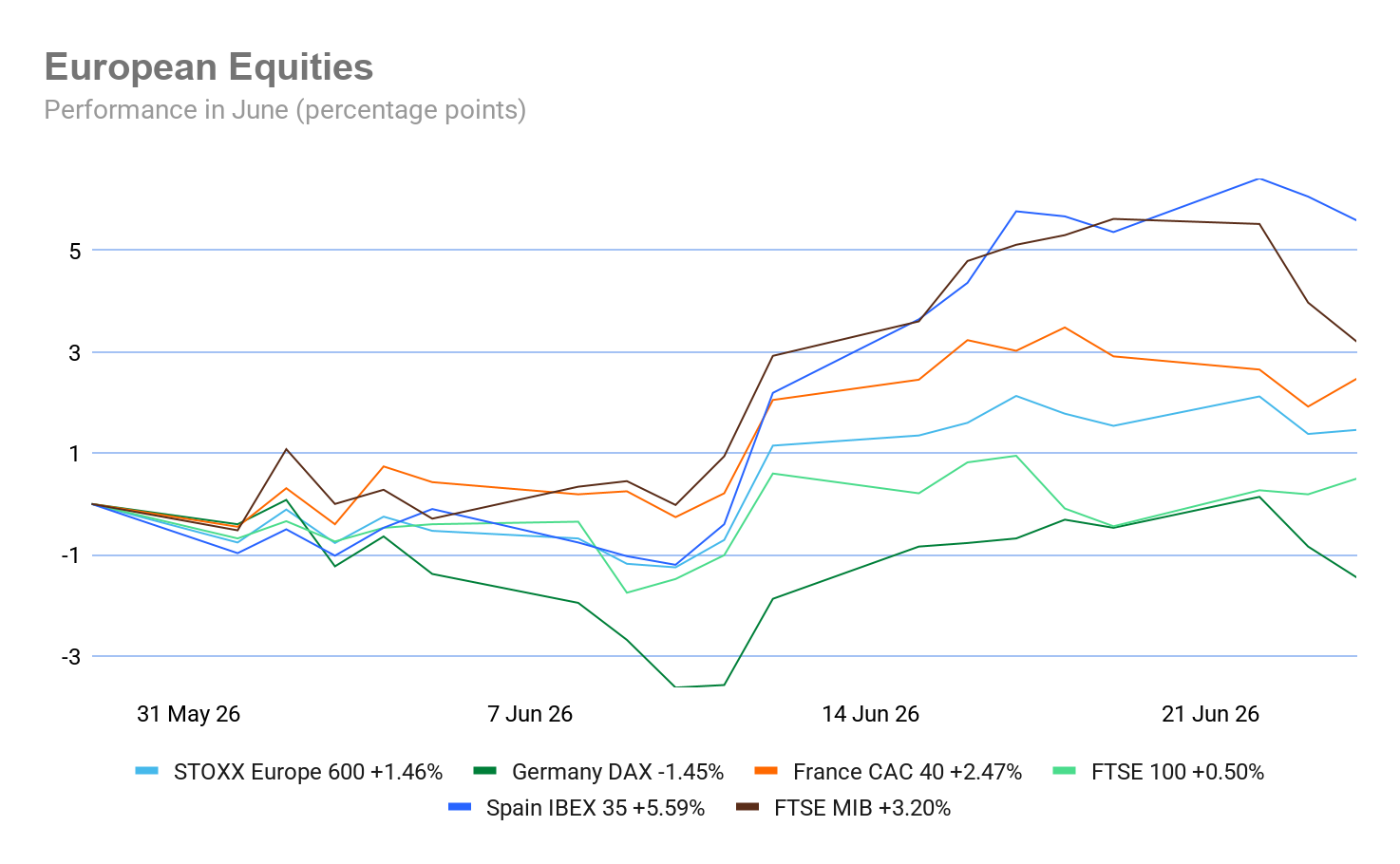
Stoxx 600 +1.46% MTD and +7.26% YTD
DAX -1.45% MTD and +1.02% YTD
CAC 40 +2.47% MTD and +2.90% YTD
FTSE 100 +0.50% MTD and +5.34% YTD
IBEX 35 +5.59% MTD and +12.03% YTD
FTSE MIB +3.20% MTD and +14.89% YTD
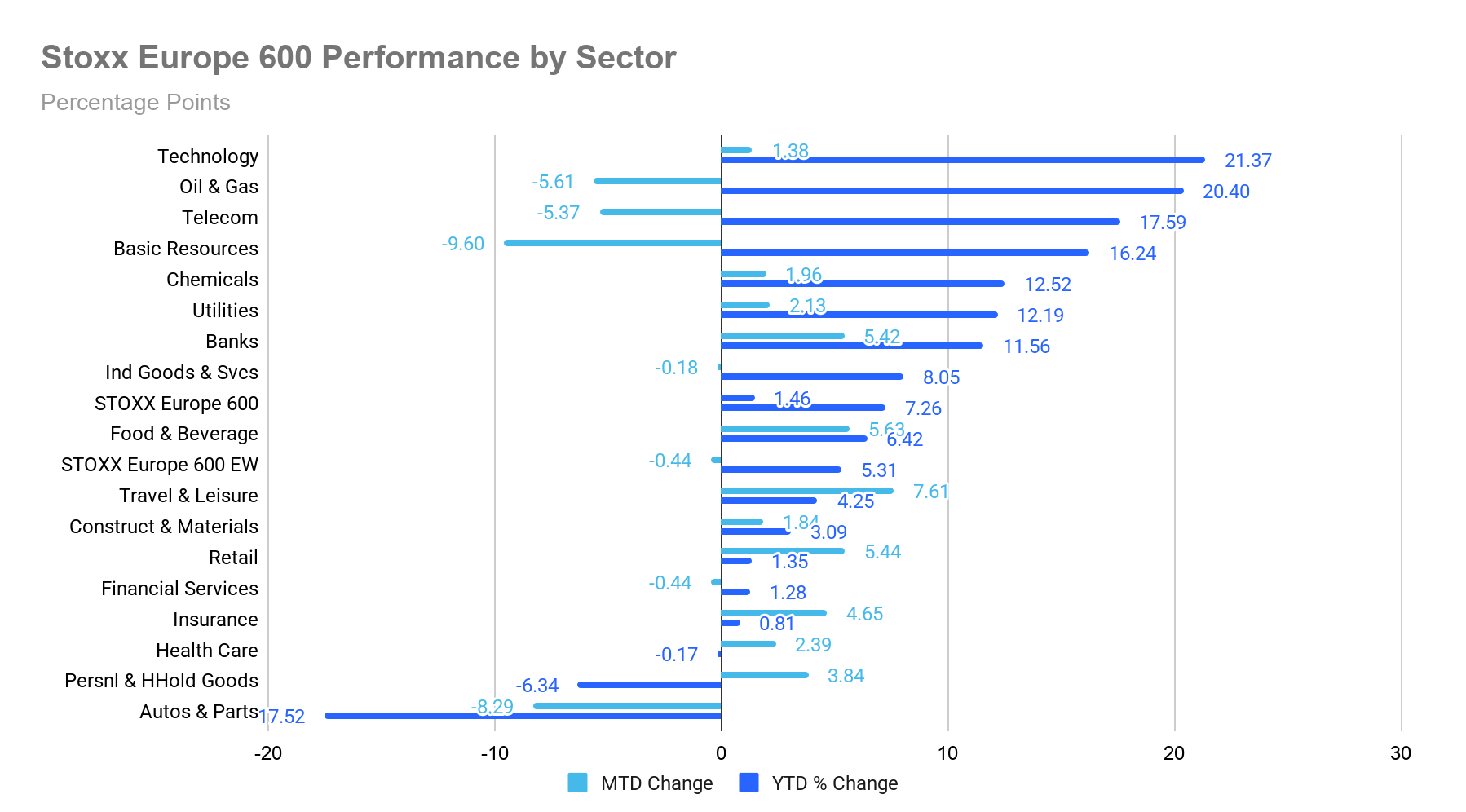
Source: FactSet
In Europe, the Equally Weighted version of the Stoxx 600 is -0.44% MTD, 1.90 percentage points lower than the benchmark.
The Stoxx 600 Travel & Leisure is the leading sector, +7.61% MTD and +4.25% YTD, while Basic Resources exhibited the weakest performance at -9.60% MTD and +16.24% YTD.
Real Estate was the standout performer on Wednesday, led primarily by SEGRO, which rose sharply after rejecting a £12.6 billion unsolicited takeover approach from Prologis. Analysts said the proposal underscored the strategic value of European logistics and data-centre assets, improving sentiment across the sector and supporting names such as MERLIN Properties and Primary Health Properties. Berkeley Group also advanced after reporting results that were broadly ahead of expectations.
Food & Beverages, along with Personal & Household Goods, benefitted from a broader rotation into selective defensive sectors. Telecoms also outperformed on broker activity, with Telecom Italia trading higher and Poste Italiane gaining after Barclays upgraded the stock to Overweight, citing potential EPS accretion from a possible TIM transaction. Retail was supported by company-specific developments, including JD Sports beginning trading in New York and B&M European Value Retail appointing a new CFO.
On the downside, Oil & Gas and Basic Resources lagged as crude prices retreated on optimism surrounding US - Iran negotiations and the potential reopening of shipping routes through the Strait of Hormuz. Lower commodity prices weighed on energy majors and miners, with Anglo American among the notable decliners despite completing a definitive joint mine plan with Codelco for the Los Bronces and Andina copper assets in Chile. The agreement is expected to unlock 2.7 million tonnes of additional copper over 21 years.
Insurance stocks also came under pressure after Allianz warned that the industry faces significant claims related to shipping damage stemming from the Iran conflict. Industrial goods and services underperformed, led by defence stocks. Rheinmetall shares fell sharply after reports suggested Germany may cancel the €12.8 billion F126 frigate programme, while rival shipbuilder TKMS rose on expectations that it could benefit from replacement naval orders. Airbus was also in focus after reports indicated that regulators had ordered inspections of certain A380 aircraft.
Global Equities
MSCI World Index -2.14% MTD and +9.06% YTD
Hang Seng -7.03% MTD and -8.66% YTD
Mega cap stocks have had a decidedly negative performance MTD. Thus far in June, Nvidia -5.75%, Apple -6.08%, Alphabet -9.22%, Meta Platforms -11.83%, Amazon -13.44%, Tesla -13.83% and Microsoft -18.83%.
Energy stocks experienced a negative performance thus far in June with the Energy sector -4.48% MTD. So far in June, Marathon Petroleum -0.91%, Phillips 66 -4.12%, Shell -5.50%, ExxonMobil -5.76%, Chevron -6.03%, ConocoPhillips -6.19%, Apa Corp -8.52%, Occidental Petroleum -9.78%, Baker Hughes Company -11.74%, Halliburton -12.74% and Energy Fuels -14.89%.
Materials and Mining stocks have had a negative performance MTD in June. The Materials sector is +0.10% MTD. So far this month, Nucor Corporation -3.79%, Freeport-McMoRan -5.89%, CF Industries Holdings -8.24%, Celanese Corporation -9.58%, Yara International -12.29%, Mosaic -12.72%, Newmont Mining -14.36%, Albemarle -16.20% and Sibanye Stillwater -26.45%.
Commodities
Gold dropped to its lowest level in more than seven months on Wednesday, trading below the key $4,000-per-ounce mark as a stronger US dollar weighed on prices.
Spot gold fell -2.66% to $3,999.06 an ounce after touching its weakest level since November 2025.
The firmer US dollar made dollar-denominated bullion more expensive for buyers using other currencies. Since reaching a record high of $5,594.82 in late January, spot gold has declined -28.52%. It is -11.83% MTD and -7.30% YTD.
Spot silver also weakened, dropping -6.74% to $57.44 after reaching its lowest level since November 2025. It is -23.68% MTD and -19.40% YTD.
Global oil prices fell more than four percent on Wednesday, settling at their lowest levels since before the start of the Iran war as supply concerns eased and additional stranded tankers exited the Strait of Hormuz.
Brent crude futures settled $3.70, or -4.81%, lower at $73.16 a barrel, while US WTI declined $3.18, or -4.35%, to $73.16 a barrel. Brent is -20.47% MTD and +20.11% YTD, while WTI is -20.39% MTD and +21.70% YTD.
Brent touched an intraday low of $73.12, its weakest level since 27 February, the day before US - Israeli strikes on Iran. US crude futures briefly fell below $70 a barrel for the first time since 2 March.
US Energy Secretary Chris Wright said crude oil flows through the Strait of Hormuz had returned close to pre-war levels, supported by military escorts helping tankers move through the key waterway.
Speaking at the Reuters Global Energy Forum in New York, Wright said around 20 million barrels of crude oil had exited the Strait of Hormuz over the previous 24 hours. He added that the return to normal navigation had been delayed by Iranian mines in the strait. Wright said Iran would not be able to block the strait going forward, adding that the US would ensure oil flows continued even without an agreement with Tehran.
Shipping data showed that three stranded tankers carrying 5 million barrels of crude oil were leaving the strait on Wednesday, with two bound for Asia, as the interim agreement between Iran and the US released additional supply trapped in the Gulf.
Physical crude cargoes were trading at discounts globally, reshaping trade flows as markets adjusted to rising Middle Eastern supply and expectations that Iran would increase sales following a temporary reprieve from US sanctions.
Brent crude for second-month delivery also traded above prompt prices for the first time since the war, signalling increased near-term supply.
Oman said it would keep the strait open to shipping without imposing tolls. It has designated two temporary routes, north and south of the existing shipping lane, to support the safe passage of vessels leaving the region.
Russia’s 250,000 bpd Moscow refinery is expected to remain offline for at least six months following multiple Ukrainian strikes last week. The Tyumen refinery was also struck intraday, while Russia is reportedly considering gasoline imports amid widespread shortages and a possible ban on diesel exports. Bloomberg tanker data showed Russian seaborne crude exports reached year-to-date highs last week, as refinery outages freed up additional supply.
Iraq’s prime minister called on OPEC to raise supply in line with its production capacity. The next OPEC-7 meeting is scheduled for 5 July.
Libyan production approached 1.5 million bpd, with the National Oil Corp reporting nationwide output of 1.44 million bpd on Sunday and condensate production of 49,000 bpd, the country’s highest output since 2013.
EIA report: US crude inventories fell to their lowest level since 1984 last week, the Energy Information Administration said on Wednesday, reflecting strong refinery demand and continued releases from the government’s emergency reserve.
Total US crude stocks, including commercial inventories and barrels held in the Strategic Petroleum Reserve, declined by 15.1 million barrels to 743.3 million barrels in the week ended 19 June, marking their lowest level in more than 41 years.
Commercial crude inventories fell by 6.1 million barrels to 412.1 million barrels, their lowest level since January 2025, while stocks in the Strategic Petroleum Reserve dropped by 9.05 million barrels to 331.2 million barrels, the lowest level since June 1983.
The Iran war has disrupted global supply flows and prompted more import-dependent economies in Asia and Europe to increase purchases of US crude, contributing to the drawdown in inventories to multidecade lows.
At the Cushing, Oklahoma delivery hub, crude stocks declined by 1.1 million barrels, reaching their lowest level since October 2014.
Refinery crude runs fell by 81,000 bpd last week, while utilisation rates decreased by 0.6 percentage points to 96.1%.
Product inventories moved higher. US gasoline stocks rose by 2.1 million barrels to 216.3 million barrels, while distillate stockpiles, including diesel and heating oil, increased by 3.1 million barrels to 106.1 million barrels.
Demand indicators weakened, with total product supplied falling by 413,000 bpd to 20.27 million bpd. Gasoline demand declined by 437,000 bpd to 8.78 million bpd, while distillate demand slipped by 126,000 bpd to 3.53 million bpd.
Net US crude imports increased by 94,000 bpd last week.
Dallas Fed energy survey. The 2Q 2026 Dallas Fed Energy Survey showed a notable improvement in oil and gas sector activity, according to executives responding to the survey. The business activity index, the broadest measure of conditions facing energy firms in the Eleventh District, rose to 46.1 in Q2 from 21.0 in Q1, marking its strongest reading since Q2 2022. The survey was conducted from 9 June to 17 June, as the US and Iran negotiated a memorandum of understanding aimed at ending hostilities.
The company outlook index remained positive but eased to 29.3 in Q2, indicating continued improvement in outlooks relative to the prior quarter. Exploration and production firms were notably more optimistic, with an outlook index of 48.2, while services firms remained cautious at -4.4.
Oil production increased modestly during the quarter, while natural gas production registered only limited gains, according to executives at exploration and production firms. Cost pressures accelerated compared with the previous quarter.
Labour market indicators improved slightly, with firms reporting a modest increase in demand for employees and a rise in hours worked.
Capital spending also strengthened, with the capital expenditures index rising to 40.9 from 21.2 in Q2 and 49% of firms reporting increased spending. However, the expected capital expenditures index for the year ahead was flat at 0, suggesting cautious long-term planning despite current spending increases.
Currencies
The US dollar advanced for a third consecutive session on Wednesday, reaching a 13-month high as market sentiment continued to favour the greenback.
The dollar index rose +0.20% to 101.58 after touching 101.80, its highest level since 12 May 2025. The move marked the dollar’s longest winning streak since the start of the month and its fifth gain in the past six sessions. The US dollar index is +2.66% MTD and +3.36% YTD.
The euro declined -0.25% to $1.1355. Against the US dollar, the euro is -2.60% MTD and -3.32% YTD.
Sterling weakened -0.34% to $1.3154 after falling to $1.3137, its lowest level since November. The currency also recorded a second consecutive daily decline following Prime Minister Keir Starmer’s resignation on Monday. The British pound is -2.23% lower against the US dollar MTD and -2.37% YTD.
Against the Japanese yen, the dollar gained +0.15% to ¥161.76. A move above ¥161.96 would push the yen to its weakest level since 1986. The yen is -1.57% MTD and -3.26% YTD.
Former BoJ policymaker Sayuri Shirai said the yen could weaken to ¥165 per dollar if the Fed raises interest rates this year. Additionally, a Summary of Opinions from the BoJ’s June policy meeting showed that some board members supported additional rate hikes to bring the policy rate closer to levels considered neutral for the economy.
Cryptocurrencies
Bitcoin -17.10% MTD and -30.67% YTD to $60,795.86
Ethereum -19.73% MTD and -45.91% YTD to $1,611.13
Bitcoin was -2.76% and Ethereum was -3.24% on Wednesday. The cryptocurrency market has seen a sharp downward correction in June; Bitcoin is down over 50% from its October 2025 all-time high. This drop was driven by macroeconomic headwinds coming from a stronger than expected US economy, which has raised the likelihood of tighter monetary policy, causing the dollar to surge and making risk assets less attractive. Cryptocurrencies have also been hit by heavy institutional ETF outflows, leveraged long liquidations, a drop in investor confidence following the limited sale of Bitcoin by Strategy and a broader market rotation towards AI stocks.
Note: As of 5:00 pm EDT 24 June 2026
Fixed Income
US 10-year yield -5.2 bps MTD +21.9 bps YTD to 4.391%
German 10-year yield -7.6 bps MTD +0.6 bps YTD to 2.866%
UK 10-year yield -15.2 bps MTD +37.8 bps YTD to 4.685%
US Treasury yields declined on Wednesday as investors continued to assess the likelihood of further Federal Reserve tightening later this year.
Although shorter-dated yields initially reflected expectations for higher borrowing costs, broader Treasury yields moved lower after policymakers signalled that persistent inflation above the Fed’s 2% target could still warrant additional rate increases.
The two-year note yield, which typically tracks expectations for the Fed funds rate, fell -4.9 bps to 4.158%, its lowest level since 17 June. The yield on the 10-year note declined -11.1 bps to 4.391%, the lowest since 11 May.
Longer maturities also rallied, with the 30-year Treasury yield falling -10.8 bps to 4.840%, its lowest level since 8 April.
The yield curve between two- and 10-year notes has bear flattened by 18.3 bps so far in June, narrowing to 25.7 bps from 44 bps at the end of May.
In policy commentary, US Treasury Secretary Scott Bessent applauded Fed Chair Warsh’s proposal to reduce forward rate guidance, while emphasising that Fed policymakers should remain open-minded about the inflationary impact of the Iran conflict and the productivity gains associated with artificial intelligence models.
Market participants were also monitoring a pending Supreme Court decision related to the US President’s efforts to dismiss Fed Governor Lisa Cook.
Demand was subdued at the Treasury Department’s $70 billion auction of five-year notes, the second sale in this week’s $183 billion package of short- and intermediate-term coupon-bearing debt.
The notes were sold at a high yield of 4.200%, the highest auction yield since January 2025 and nearly one basis point above their pre-auction trading level. The bid-to-cover ratio stood at 2.35, its strongest reading since December.
The Treasury is scheduled to sell $44 billion in seven-year notes today.
The yield on the US 10-year Treasury note is -5.2 bps MTD for June so far. The US 30-year yield is -13.0 bps lower over the course of the month. At the short end, the two-year Treasury yield is +14.8 bps MTD.
Current sentiment in the Fed funds futures market, according to CME's FedWatch Tool, suggests a 34.2% probability of rates at the July FOMC. It’s pricing 35.1 bps of rate hikes through 2026, higher than 24.6 bps a month ago.
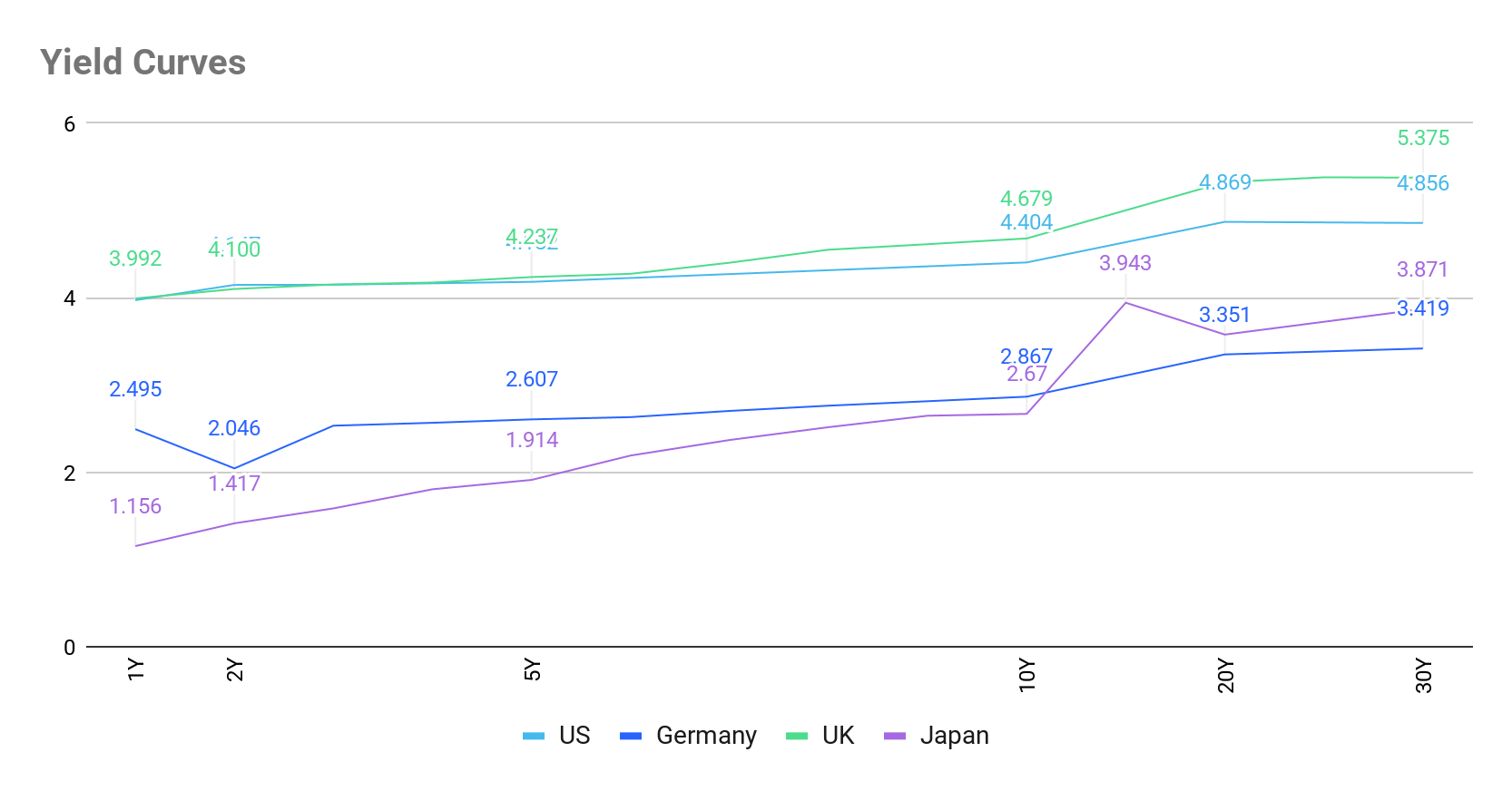
Source: FactSet
In the UK, the 10-year gilt fell by -7.4 bps to 4.685% on Wednesday. On the short end, the 2-year gilt was -2.9 bps lower to 4.143%. The UK's 30-year gilt yield declined by -8.1 bps to 5.377%. In the UK, the 10-year gilt yield is -13.6 bps MTD. The UK 30 year is -14.1 bps so far in June.
Across the channel, German 10-year Bund yields fell to a three-month low on Wednesday, as a further decline in oil prices reinforced expectations that eurozone inflation would remain broadly contained and limit the need for more aggressive ECB policy tightening.
The German 10-year Bund yield declined -5.8 bps to 2.866%, its lowest level since 11 March.
This week’s rally was supported by comments from ECB President Christine Lagarde, who told the European Parliament on Monday that there was no evidence of an inflation pickup that would justify more forceful policy action. Softer inflation signals in Tuesday’s business activity data further strengthened that view.
The shift in sentiment was also reinforced by last week’s initial agreement between the US and Iran, which allowed shipping to resume through the Strait of Hormuz. The resulting drop in Brent crude prices reduced concerns that energy costs would feed into broader inflation pressures.
Markets are still pricing in one additional 25 bps increase by the ECB by year-end, following its policy tightening earlier this month. However, investors now see little likelihood of a third move in 2026.
Moves in ECB-sensitive short-dated yields were more limited, with Germany’s 2-year Schatz yield down -3.0 bps at 2.559%. The 30-year yield fell -6.3 bps to 3.413%, its lowest level since 1 April.
Other eurozone bond markets moved broadly in line with Germany. Italy’s 10-year yield declined -4.0 bps to 3.596%, its lowest level since 13 March. The spread between Italian 10-year BTPs and Bunds stood at 73.0 bps. During June the spread of Italian 10-year BTPs over Bunds has increased by 1.9 bps so far. The Italian 10-year BTP yield has declined by -5.7 bps MTD.
The German 10-year yield is -7.6 bps MTD for June. The spread between US 10-year Treasuries and German Bunds stands at 152.5 bps, reflecting an increase of 2.4 bps over the month so far, from 150.1 bps at the end of May.
The 2-year Schatz increased +0.2 bps MTD and the German 30-year yield is -8.2 bps lower MTD.
Note: As of 5:00 pm EDT 24 June 2026
What to think about in July 2026
No line of sight: energy, the Fed's pivot and the long end of the AI cycle. The past month has brought into unusually sharp relief the three structural tensions that will govern capital allocation across multi-asset portfolios through the remainder of 2026: an energy-driven inflation shock that has now hardened the Fed's policy stance into something approaching a genuine tightening bias; a debate about whether the AI investment cycle represents real industrial transformation or capital misallocation at historic scale; and — emerging with force this week — concrete evidence from the semiconductor supply chain that the AI build-out is, at its core, a memory-constrained phenomenon whose resolution timeline may be measured in years, not quarters.
The June FOMC meeting under new Chair Kevin Warsh delivered the most consequential policy signal of the year. The Committee held the federal funds rate at 3.50% – 3.75% for a fourth consecutive meeting, but the accompanying dot plot marked a decisive inflection: nine officials now project at least one rate hike in 2026, up from none in March, while markets now assign close to a 90% probability of a hike by year-end. The Fed's preferred inflation gauge was revised upward to 3.6%, nine-tenths above the March projection, with the statement acknowledging that elevated prices reflect ‘supply shocks that have led to price increases in certain sectors, including energy’.
The energy channel runs directly through the war in Ukraine. The IEA reported in June that Russian crude production fell roughly 5% y/o/y to 8.7 million barrels per day in May, approximately 10% below target, as Ukrainian drone strikes on Russian oil refineries, attacks that have more than doubled since the start of 2026, imposed binding capacity constraints on Moscow's downstream infrastructure. The paradox, as documented by Reuters, is that these strikes are simultaneously driving Russia to maximise crude exports while curtailing domestic supply, keeping the global oil price transmission mechanism active even as geopolitical negotiations make halting progress. As France, Germany and the UK pushed for direct talks between Russia and Ukraine in June and Ukraine signalled it may revise its ceasefire offer, the market finds itself holding a binary risk: any durable settlement along the lines of the US-brokered framework would remove a meaningful share of energy risk premium almost immediately, with direct implications for the Fed's inflation trajectory and, by extension, the rate environment in which AI CapEx is being underwritten.
That rate environment matters because the AI infrastructure super-cycle has become one of the most active sources of duration supply in global fixed income markets. The five largest US hyperscalers issued $121 billion in investment-grade corporate bonds in 2025 alone, compared to an annual average of $28 billion between 2020 and 2024. By mid-March 2026 the group had already surpassed that figure, with off-balance-sheet project finance vehicles layering additional systemic exposure into private credit and insurance markets. Higher-for-longer rates raise the weighted average cost of capital for projects whose return horizons extend across years. Allianz Research has confirmed that the correlation between energy price volatility and US technology sector CapEx is among the strongest across all S&P 500 sectors since 2000.
The AI bubble debate itself has entered a more nuanced phase. Reuters reported that OpenAI burned $3.7 billion in Q1 2026 on $5.7 billion of revenue, a ratio that captures the core temporal mismatch: infrastructure commitment is long-dated; monetisation is not yet at scale. Goldman Sachs, by contrast, has noted that AI CapEx now represents roughly 0.8% of GDP, still nearly half the 1.5% share reached during comparable tech booms over the past 150 years, arguing that current valuations remain within historical precedent. The debate is not settled, but this week's semiconductor earnings have contributed fresh and consequential evidence on the demand side.
Micron Technology's Q2 results, released Wednesday evening, delivered the single most important data point for the AI trade in recent weeks. Quarterly revenue reached $41.5 billion, far above the consensus of $35.6 billion, with guidance for Q3 set at $50 billion, above consensus. CEO Sanjay Mehrotra was unequivocal: there is ‘no line of sight’ on when the HBM market will reach balance, with tightness expected to persist beyond 2027 before any gradual improvement in 2028. Underpinning the durability of this signal was the announcement of 16 long-term Strategic Customer Agreements worth approximately $22 billion over three to five years, a degree of contracted volume commitment that structurally differentiates the current cycle from prior boom-bust memory episodes. Micron's HBM capacity for calendar 2026 is fully sold out; customer discussions have already extended into 2027.
Qualcomm's investor day added a second vector to the AI trade narrative, one that speaks to the broadening of the semiconductor opportunity beyond DRAM and HBM. The company upgraded its projected annual revenue from non-handset businesses to $40 billion by fiscal 2029, more than doubling its previous $22 billion forecast, and set a specific $15 billion target for its data centre business by that year, with $5 billion expected in fiscal 2027. The revelation that Meta Platforms has signed as a customer for Qualcomm's new high-bandwidth compute chips, designed to achieve superior energy efficiency relative to conventional high-bandwidth memory, underlines a dynamic that is becoming a first-order competitive variable in silicon procurement: watts per dollar now ranks alongside raw compute performance in hyperscaler vendor selection. SK Hynix's concurrent filing for a $29 billion Nasdaq ADR listing, scheduled to begin 10 July, completes a picture of a supply chain simultaneously expanding capacity, deepening Western capital market integration, and, in Samsung's case, building on momentum from its own buyback announcement — narrowing the valuation discount to US-listed peers.
As investors navigate the weeks ahead, several developments warrant close attention. First, the trajectory of energy prices and any diplomatic breakthrough in Ukraine remain the most direct variables for the Fed's reaction function; a credible ceasefire framework would be the single most consequential macro catalyst for a repricing of rate-hike expectations and a compression of the risk premium currently embedded in long-duration AI infrastructure assets. Second, the SK Hynix Nasdaq debut on 10 July will provide a real-time read on institutional appetite for the AI memory trade. If fully subscribed, it will represent a validation of committed capital flows into the build-out at a scale that is without modern precedent in global equity markets. Third, the July FOMC meeting will clarify whether the June dot-plot shift was a signal of intent or an expression of optionality; the language around energy price treatment and core inflation will be scrutinised closely by fixed income and AI infrastructure investors in equal measure. Finally, hyperscaler Q2 earnings, due through mid-July, will provide the application-layer validation test that ultimately underwrites every segment of the capital stack: sustained compounding in Azure, AWS, and Google Cloud AI revenues remains the fundamental support for the entire memory-to-infrastructure thesis. A deceleration here would compress multiples across the AI complex simultaneously; further confirmation would reinforce the view that the memory supercycle and the CapEx build-out are two expressions of the same structural force, one that is, for now, proving considerably more durable than the sceptics anticipated.
Key events in July 2026
The potential policy and geopolitical risks for investors that could affect corporate earnings, stock market performance, currency valuations, sovereign and corporate bond markets and cryptocurrencies include:
1 July USMCA review deadline day. The US, Mexican and Canadian governments must decide on the USMCA’s sixth anniversary if they want to extend the agreement. US Trade Representative Jamieson Greer has indicated that due to the complexity of unresolved disputes, negotiations are likely to extend beyond the 1 July deadline.
7-8 July NATO Summit, Ankara, Turkiye. Heads of state and government of the 31 NATO member countries will gather to review the Alliance’s policies and contributions. There is likely to be significant disagreement around burden sharing, with the European members taking on a greater role following criticisms from the Trump administration. Topics will likely cover defence spending, defence industrial production and support for Ukraine.
14-17 July Aspen Security Forum, Colorado. USA. This national security and foreign policy forum in the US will host a global dialogue on national security. The event brings together leading decision-makers, national security experts, high-level cabinet members, heads of intelligence agencies, business leaders and innovators.
23 July ECB Monetary Policy Meeting. Although the ECB raised rates by 25 bps during the June meeting, ECB President Christine Lagarde has stated recent economic data did not demand a ‘more forceful policy response at this stage’. With eurozone growth slowing and if oil prices continue to fall, assuming the ceasefire with Iran holds, then the ECB will be unlikely to raise rates again at this meeting although markets have priced in an additional rate rise this year.
24 July 2026, USA. The Trump administration announced temporary global tariffs under Section 122 of the Trade Act of 1974 after the US Supreme Count invalidated the previous tariffs imposed under the International Emergency Economic Powers Act (IEEPA). These were initially set at 10%. These tariffs will expire on 24 July, but the Trump administration is likely to impose new measures before this deadline.
28-29 July Federal Reserve Monetary Policy Meeting. The new Fed chair Kevin Warsh promised that the Fed will deliver price stability, and with the labour market remaining resilient and the economy still growing, inflation is likely to continue to rise, even if the war with Iran ends and energy prices fall. PCE remains almost double the Fed target. With inflation remaining above target for almost 6 years, Warsh may convince other policymakers of the need to raise rates to show the commitment and ability to fight inflation.
30 July Bank of England Monetary Policy Meeting and Monetary Policy Report. The BoE’s MPC voted 7-2 to keep rates on hold with two members voting for a quarter-point rise during the June meeting. With growth slowing, the MPC will be reluctant to raise rates quickly as it will likely pause to see if inflation continues to rise or if the slack in the labour market will be enough to hold off on a rate rise at this meeting. However, following the June meeting, BoE governor Andrew Bailey said that while he was willing to temporarily tolerate above-target inflation, he would respond “promptly” to any signs of widening inflationary pressures. Markets are currently pricing in a rate rise later this year, most probably in September.
30-31 July Bank of Japan Monetary Policy Meeting. At the June meeting, the BoJ raised rates to a 31-year high of 1%, an important step in its policy normalisation. It also signalled readiness to tighten further, with several members noting the impact of continuing price pressures and the weaker yen on inflation expectations. However, if energy prices continue to fall, then the downside risks to output and jobs will decline. Although BoJ Governor Kazuo Ueda has reiterated the central bank's resolve to keep raising interest rates as underlying inflation approaches its 2% target and financial conditions remain accommodative, another rate rise is unlikely at this meeting.
While every effort has been made to verify the accuracy of this information, EXT Ltd. (hereafter known as “EXANTE”) cannot accept any responsibility or liability for reliance by any person on this publication or any of the information, opinions, or conclusions contained in this publication. The findings and views expressed in this publication do not necessarily reflect the views of EXANTE. Any action taken upon the information contained in this publication is strictly at your own risk. EXANTE will not be liable for any loss or damage in connection with this publication.
Ten artykuł jest publikowany wyłącznie w celach informacyjnych i nie powinien być traktowany jako oferta lub zachęta do kupna lub sprzedaży jakichkolwiek inwestycji lub powiązanych usług, do których można się tu odwołać. Obrót instrumentami finansowymi wiąże się ze znacznym ryzykiem strat i może nie być odpowiedni dla wszystkich inwestorów. Wyniki osiągnięte w przeszłości nie są wiarygodnym wskaźnikiem wyników w przyszłości.




Zarejestruj się i otrzymuj informacje rynkowe
Zarejestruj się i otrzymuj
informacje
rynkowe
Subskrybuj teraz Subskrybuj teraz


Stworzone przez profesjonalistów. Dla profesjonalistów.
