

Liberté, égalité, solvabilité?


 S&P 500 +0.58% to 7,757.17 US 10-year yield +1.4 basis points to 5.129% Spot gold +0.40% to $4,140.43 an ounce DXY -0.02% to 101.69
What to look out for today
Companies reporting on Thursday, 22nd October: Blackstone, Procter & Gamble, Spotify, Newmont, Lockheed Martin, Valero Energy, Bloom Energy, Union Pacific, Western Digital, Norfolk Southern, Honeywell, Dow, Omnicom
Key data to move markets today
EU: A speech by Bank of Italy Governor Fabio Panetta and Eurozone Consumer Confidence
UK: A speech by BoE Governor Andrew Bailey
US: Initial and continuing jobless claims
Global Macro Updates
The spread of discontent. France’s problem is not just that its 10-year yield, now more than 5%, sits above the former EU debt crisis basket cases of Portugal, Italy, Greece and Spain. The problem is its diminishing capacity to stabilise debt at that price. Voters oppose fiscal tightening as creditors increasingly demand it, creating a political constraint that higher borrowing costs only tighten.
Even the proposed €54 billion adjustment leaves government projections showing debt rising from 119.3% of GDP in 2026 to 121.7% in 2027. Stabilisation could require a five-percentage-point improvement in the primary balance, towards a 2% surplus. Pension, healthcare and defence commitments collide with parliamentary fragmentation and the 2027 election. Consolidation also weakens growth. Meanwhile, just under €1 trillion of debt matures by 2030, with refinancing increasingly absorbing savings that politicians struggle to secure.
Moody’s ratings review due this Friday could support a downgrade on grounds extending beyond the debt-to-GDP ratio. Persistent primary deficits, rising interest costs relative to revenue, heavy borrowing needs and weaker institutional capacity to deliver a multiyear fiscal adjustment all come into consideration. The budget’s assumed 4.3% ten-year yield already looks optimistic against 5% market rates. Yet maturity structure delays the full repricing of outstanding debt; deteriorating affordability is not synonymous with imminent insolvency. French yields already suggest considerable deterioration is priced in.
The risk travels through sovereign portfolios and bank wholesale funding, then into corporate borrowing costs and equity valuations. This can also weaken the euro and widen neighbouring sovereign spreads. But this is not a guaranteed replay of 2011 as the banks have stronger buffers. Bloomberg’s repo-market reporting found funding plumbing intact. Indiscriminate selling of European equities could therefore overshoot, particularly among internationally diversified businesses benefitting from a weaker euro. Conversely, leveraged deleveraging can amplify otherwise justified sovereign repricing.
The distinction between a global rise in yields and France-specific fiscal pressure is crucial, as tighter spreads may not reduce refinancing costs. Investors should watch repo conditions and bank funding spreads for signs that valuation pressure is turning into liquidity stress. The ECB is not an unconditional backstop because its framework addresses unwarranted market dysfunction rather than risk premia justified by deteriorating fundamentals. Passing the budget may ease positioning pressure, but a lasting recovery requires credible debt stabilisation rather than another short-term financing deal.
US Stock Indices
Dow Jones Industrial Average +0.69%
Nasdaq 100 +1.13%
S&P 500 +0.58%, with 7 of the 11 sectors of the S&P 500 up
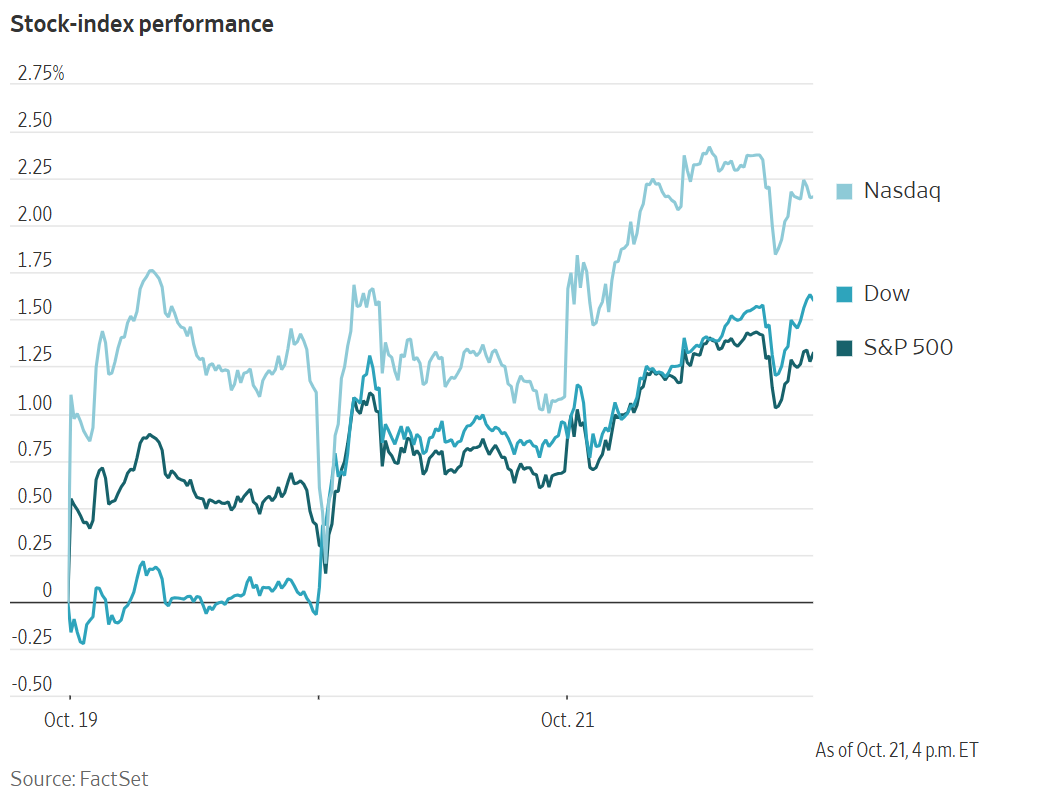
US equity indices were up on Wednesday, with the Nasdaq Composite leading the way. The Dow Jones Industrial Average advanced 360,21 points, or +0.69%, to 52,856.09, the S&P 500 traded 44.60 points higher, or +0.58%, to 7,757.17 and the Nasdaq Composite rose by 278.04 points, or +1.05%, to 26,702.86.
In corporate news, Meta raised the lower end of its annual spending forecast and said it would introduce new non-voting shares, in a move that would help fund its expensive AI expansion. Also on Wednesday, a judge in New Mexico ordered Meta to pay $25 billion after a jury found the company guilty of misleading consumers following allegations that a political consulting firm involved in Donald Trump's 2016 presidential campaign obtained data from millions of Facebook users without their consent.
Abbott Laboratories plans to spin off its nutrition business into a standalone publicly traded company with $8.5 billion in annual sales, following costly litigation involving infant formula. Abbott shareholders will receive shares in the new entity through a tax-free spin-off expected to be completed by the end of next year. Abbott Nutrition executive Daniel Salvadori will serve as chief executive of the new company.
Corporate Earnings Reports
Posted on Wednesday, 21 October from The Pulse, our real-time AI-driven news tool. Available exclusively on the EXANTE Web Platform
Abbott Laboratories reported third-quarter net sales of $13.01bn vs $13bn estimated, alongside adjusted EPS of $1.42 vs $1.42 estimated, with comparable sales rising up +7%. For the fourth quarter, the group expects adjusted EPS of $1.62 to $1.67 vs $1.64 estimated. Full-year adjusted EPS guidance was narrowed to between $5.50 and $5.55 from the prior $5.45 to $5.60 range, whilst full-year 2026 comparable sales are projected to grow up +6.0%. Additionally, Abbott announced plans to spin off its nutrition business into a separate publicly traded company to focus on high-growth divisions.
CME Group reported Q3 2026 revenue of $1.74bn vs $1.71bn expected and adjusted EPS of $3.02 vs $2.98 expected, rising up +13% y/y. Adjusted operating income reached $1.21bn vs $1.19bn expected, supported by market data revenue increasing up +20% y/y to $243.1mn. Total average daily volume reached 29.4mn contracts, with double-digit growth across all major asset classes. In legal developments, the CFTC asked a federal court to dismiss CME Group's lawsuit against its cryptocurrency perpetual futures policy, claiming the exchange failed to show financial harm. Management stated that the group launched multiple innovative products and generated a record $100bn in average daily capital efficiencies.
Danaher reported its Q3 2026 financial results before market open. Adjusted EPS rose +11.5% y/y to $2.11 vs $1.91 expected, whilst revenue increased +8.5% y/y to $6.55bn vs $6.56bn expected. Core revenue grew +3.0% y/y, with operating cash flow reaching $1.89bn, up +13.5% y/y, and free cash flow rising +19.0% y/y to $1.63bn. For FY26, the company raised its adjusted EPS guidance to between $8.57 and $8.62 vs $8.51 expected, projecting full-year core revenue growth of approximately +2.5% y/y. For Q4, core revenue is forecast to grow +4.0% to +5.0% y/y with adjusted operating margins of approximately 29.5%. The chief executive officer noted that the company delivered better-than-expected quarterly results and expressed encouragement regarding improving trends across end markets.
Elevance Health reported its Q3 2026 financial results before market open. Revenue was $50.44bn vs $49.21bn expected, up +0.7% y/y. Adjusted EPS reached $6.99 vs $4.68 expected, up +15.9% y/y, whilst GAAP EPS rose +17.9% y/y to $6.27. Health Benefits segment revenue rose +2.6% y/y to $43.36bn, and Carelon revenue rose +5% y/y to $19.3bn. Total medical membership fell -1.1% y/y to 44.9mn. Elevance Health raised its full-year 2026 guidance, projecting adjusted EPS of at least $29.00, GAAP EPS of at least $22.00, and operating cash flow of at least $6.5bn. Management stated that the company remains confident in delivering at least +12% growth in adjusted diluted earnings per share in 2027.
NextEra Energy reported its third-quarter financial results before market open, posting adjusted EPS of $1.24 vs $1.20 expected and operating revenue of $8.09bn vs $8.5bn expected. The company maintained its full-year adjusted EPS guidance at the upper end of the $3.92 to $4.02 range. The chief executive officer noted that the company delivered strong third-quarter results. In corporate and regulatory developments, the Governor of Virginia stated that he will not support the proposed NextEra-Dominion merger without a six-year rate freeze.
AT&T reported third-quarter 2026 revenue of $32.3bn, up +5.3% y/y, beating the $31.69bn consensus estimate. Adjusted EPS rose +20.4% y/y to $0.65 vs $0.60 expected, while adjusted EBITDA reached $12.5bn vs $12.32bn expected. Operational performance included 379,000 postpaid phone net additions and 442,000 fibre net additions, alongside a $2.6bn non-cash impairment charge linked to its Mexico wireless business. For full-year 2026, AT&T raised its adjusted EPS guidance to approximately $2.40 vs $2.34 expected, although it noted fourth-quarter adjusted EBITDA will absorb approximately $100mn in legacy vendor dispute settlements and elevated customer acquisition costs. The Chief Executive Officer stated that the company's asset base and leading position in fibre position it well for the artificial intelligence era.
Thermo Fisher Scientific reported its Q3 2026 financial results, posting revenue of $12.14bn vs $11.95bn expected, up +9% y/y with organic revenue rising +6%. Adjusted EPS reached $6.68 vs $6.40 expected, up +15% y/y, whilst GAAP EPS rose +9% y/y to $4.64. Adjusted operating income was $2.97bn vs $2.87bn anticipated, supported by adjusted operating margin expansion to 24.5%. In portfolio actions, the group completed the previously announced divestiture of its microbiology business. The Chief Executive Officer stated that the company was pleased to deliver another excellent quarter with outstanding financial performance across both the top and bottom lines, adding that the group remains well positioned to drive long-term value creation through 2026.
CSX reported its Q3 2026 financial results after market close, delivering revenue of $4.02bn vs $3.96bn expected, up +12% y/y. Adjusted EPS reached $0.57 vs $0.53 expected, rising +30% y/y, while adjusted operating income came in at $1.57bn vs $1.48bn expected, with an adjusted operating margin of 39.1%. Total volume rose +5% y/y to 1.69mn units, supported by an intermodal volume increase of +7% y/y. Revenue growth was driven by higher fuel surcharge revenue as well as improved volume and pricing across merchandise, intermodal, and coal operations. Management noted that employee execution had positioned the railroad well for the fourth quarter and looked forward to continuing progress towards best-in-class performance in 2027.
IBM reported third-quarter 2026 financial results, with revenue rising +5% y/y to $17.1bn vs $16.82bn expected and adjusted EPS growing +11% y/y to $2.95 vs $2.86 expected. Software revenue rose +8% y/y to $7.8bn vs $7.64bn expected, Infrastructure expanded +4% y/y to $3.7bn, and Consulting remained flat y/y at $5.34bn vs $5.39bn expected. Free cash flow reached $3.03bn vs $2.63bn expected, while operating cash flow totalled $4bn. For the full year, the company reaffirmed constant-currency revenue growth guidance of +4% to +5% and projected free cash flow to expand by more than $1bn y/y. In corporate developments, IBM Ventures invested in Leena AI. The Chief Executive Officer stated that broad portfolio demand and strong operational execution drove accelerated growth and operating margin expansion.
Kinder Morgan reported third-quarter revenue of $4.53bn vs the $4.38bn consensus estimate and adjusted EPS of $0.35 vs $0.32 expected, up +21% y/y. Adjusted EBITDA rose +9% y/y to $2.18bn. The company expanded its overall project backlog to $14.4bn, driven by a record natural gas backlog of $13.2bn after adding $5.4bn during the quarter. Operational developments included a commitment to construct a $4.2bn natural gas pipeline to supply data centres and reaching a final investment decision on the Southeast Connector Project. The chief executive officer stated that strong customer interest in natural gas infrastructure expansion continues to support record performance and backlog growth.
Lam Research reported Q1 FY27 revenue of $8.22bn vs $8.13bn expected, and adjusted EPS of $2.20 vs $2.19 expected, with GAAP EPS up +77% y/y to $2.19. Systems revenue reached $5.7bn, customer support generated $2.5bn, and China accounted for 35% of total revenue. For Q2 FY27, the company guided revenue between $8.20bn and $9.00bn vs $8.60bn expected, alongside adjusted EPS between $2.18 and $2.48 vs $2.34 expected. Capital returns included $1.025bn in share repurchases and $325.4mn in dividends. Ahead of results, Deutsche Bank maintained a Buy rating and raised its price target to $375 from $320. Management stated that artificial intelligence demand and device complexity drove record revenue, profit, and earnings per share for the quarter.
Southwest Airlines reported Q3 2026 adjusted revenue of $8.42bn vs $8.25bn expected, up +21% y/y, and adjusted EPS of $0.66 vs $0.57 expected, up +500% y/y. For full-year 2026, the airline lowered its adjusted EPS guidance to $2.60-$2.85 vs $2.87 expected due to elevated fuel costs, alongside trimmed capacity growth of ~+1.2% y/y. Q4 adjusted EPS is forecast at $0.55-$0.80 vs $0.85 expected. Net capital spending for 2026 is guided between $2.5bn and $2.75bn. Additionally, the carrier overhauled its frequent flyer tiers and announced a new lounge network launching in 2027. Management noted that resilient demand demonstrates durable earnings power despite higher fuel expenses.
Medpace reported Q3 2026 financial results, with EPS of $4.84 vs $4.44 expected, up +25% y/y, and revenue of $716.0mn vs $716mn expected, up +8.5% y/y. EBITDA reached $172.1mn vs $161mn expected, up +16.0% y/y. Net new business awards rose +10.6% y/y to $873.4mn, and total backlog grew +5.6% y/y to $3.17bn. For full-year 2026, the company issued revenue guidance of $2.84bn to $2.86bn vs $2.85bn expected, EPS guidance of $17.97 to $18.32 vs $17.60 expected, and EBITDA guidance of $638.0mn to $652.0mn vs $628mn expected. In addition, Medpace authorised a new share buyback programme of up to $1.0bn.
Meta Platforms reported Q3 2026 revenue of $64.6bn, up +26% y/y, beating consensus of $63.33bn, and EPS of $3.83 vs $3.57 expected, which included a $9.9bn legal settlement charge. CapEx surged to $34.9bn, driving free cash flow to -$2.1bn. For Q4 2026, Meta projected revenue of $73bn to $76bn vs $73.57bn expected, while narrowing FY26 capex guidance to between $135bn and $145bn. Meta approved a new non-voting Class C share class via a one-for-one stock dividend to fund artificial intelligence expansion. Legally, Meta faced a $25bn penalty ruling in New Mexico over privacy practices. Meta also partnered with Apple to run its Muse Spark AI models locally on Mac devices. Chief Executive Mark Zuckerberg stated that core business momentum was strong and AI investments were demonstrating velocity across the board.
Reliance reported Q3 2026 revenue of $5.21bn vs $4.66bn expected, up +42.8% y/y, and adjusted EPS of $8.02 vs $6.64 expected, up +120% y/y. Non-GAAP pretax income was $544.2mn vs $455mn expected, with tons sold rising +15.6% y/y and average selling price per ton increasing +24.0% y/y to $2,815. For Q4, the company guided adjusted EPS between $7.40 and $7.60 vs $5.61 expected, alongside tons sold projected up +13.5% to +15.5% y/y. In capital returns, Reliance maintained a $1.25 per share quarterly dividend and authorised a $2.5bn share repurchase programme. Management stated that the US Department of Homeland Security border wall contract awarded earlier in the year continued to ramp up and provided another meaningful contribution to third-quarter earnings.
Tesla reported Q3 2026 revenue of $28.05bn, flat y/y, and adjusted EPS of $0.48 vs $0.44 expected. Operating income fell -56% y/y to $718mn, whilst free cash flow reached $1.53bn vs negative $4.99bn expected. Full-year capital expenditure guidance was lowered to $20bn from $25bn. Active Full Self-Driving subscriptions rose +67% y/y to 1.74mn. Operationally, Tesla commenced production of commercial-quality Optimus humanoid robots at its Fremont facility, whilst the Tesla Semi entered volume production. Additionally, Tesla and SpaceX formed independent special committees to evaluate a potential merger. Chief Executive Elon Musk stated that the firm maintained strong momentum across robotics and artificial intelligence, whilst targeting annual production of approximately 5mn vehicles by 2030.
Texas Instruments reported Q3 2026 EPS of $2.62 vs the $2.41 consensus estimate, up +77% y/y, and quarterly revenue of $6.06bn vs $5.92bn expected, up +28% y/y from $4.74bn. Segment performance was driven by Analog revenue of $4.91bn, up +32% y/y, and Embedded Processing revenue of $858mn, up +21% y/y, whilst data centre revenue rose +95% y/y. For Q4, the company guided revenue between $5.80bn and $6.30bn vs $5.73bn expected, and EPS between $2.45 and $2.79 vs the $2.29 analyst estimate. Chief Executive Officer Haviv Ilan stated that revenue increased +11% sequentially and rose +28% y/y, supported by broad growth across industrial, automotive, and data centre markets.
United Rentals reported Q3 2026 revenue of $4.9bn vs $4.7bn expected, and adjusted EPS of $15.55 vs $13.92 expected. Net income rose +31.2% y/y to $920mn, whilst total rental revenue grew +17.8% y/y to $4.32bn, driven by general rentals up +8.8% y/y to $2.61bn and specialty rentals up +34.7% y/y to $1.70bn. Full-year 2026 guidance was raised, with revenue projected between $18.0bn and $18.2bn vs $17.74bn expected, and adjusted EBITDA anticipated between $8.3bn and $8.4bn vs $8.05bn expected. The company declared a quarterly dividend of $1.97 per share and expects to complete $1.5bn of share buybacks in 2026. Management stated that the raised guidance reflects customer confidence, robust backlogs, and sustained momentum across large projects.
European Stock Indices
CAC 40 +1.06%
DAX +1.35%
FTSE 100 +0.19%
Commodities
Gold spot +0.40% to $4,140.43 an ounce
Silver spot -0.01% to $57.96 an ounce
West Texas Intermediate -3.34% to $97.71 a barrel
Brent crude +0.45% to $109.66 a barrel
Gold advanced on Wednesday, primarily due to US dollar softness. Spot gold was +0.40% to $4,140.43 per ounce.
Spot silver was -0.01% to $57.96 per ounce.
Oil prices were mixed on Wednesday as investors weighed declining oil stocks against possible progress toward Russia - Ukraine talks and no clear signs of future US - Iran dialogue.
Brent crude futures settled 49 cents, or +0.45%, higher at $109.66. WTI crude settled $3.38, or -3.34%, lower at $97.71.
Crude prices initially strengthened following reports that additional tankers had been struck in the Strait of Hormuz and comments from Iranian leaders that talks with the US would not be possible until the blockade was lifted. Despite the persistently high number of tanker attacks, oil flows through the Strait have rebounded above prewar levels, according to Kpler and other sources.
Kuwait Petroleum said yesterday afternoon that customers were again entering the Gulf to collect oil and that crude exports had returned to prewar levels, although refined products remained bottlenecked. Both benchmarks moved into negative territory around the time reports emerged that Ukraine, Russia and the US could hold talks in Abu Dhabi next month to seek an end to the war.
The benchmarks briefly rebounded after the close following a report that the State Department was preparing to order certain staff and their families to leave US embassies across the Gulf amid the possible resumption of hostilities, particularly involving Yemen’s Houthis. A State Department official later clarified that the order applied only to non-emergency employees and their families in Saudi Arabia.
The UKMTO said today that an unidentified projectile had struck a tanker 11 miles west of Bukha, Oman, overlooking the Strait of Hormuz. Media reports also indicated that Persian Gulf oil exports had surpassed prewar levels following a two-week decline. Unconfirmed reports suggested that US forces were escorting tankers through the Strait in groups.
Reuters calculations based on official data for Chinese crude imports of 9.030 million bpd, refinery throughput of 13.990 million bpd and domestic production of 4.430 million bpd suggest that refiners processed about 530,000 bpd more crude than was available in September. This marked the fourth consecutive estimated inventory draw.
The US DOE Weekly Petroleum Status Report showed a crude inventory draw of 3.060 million barrels, driven by a further 457,000 bpd decline in Lower 48 production following Hurricane Isaias. At 12.757 million bpd, Lower 48 output was more than 730,000 bpd below its pre-Isaias level.
Crude stockpiles fell to their lowest seasonal level since 2014. Gasoline inventories declined by 2.950 million barrels, supported by a 575,000 bpd increase in implied demand and a 360,000 bpd rise in net exports. Distillate inventories increased by 1.680 million barrels as implied demand fell by 590,000 bpd w/o/w.
Note: As of 4 pm EDT 21 October 2026
Currencies
EUR -0.04% to $1.1232
GBP +0.13% to $1.3394
Bitcoin +2.25% to $84,635.97
Ethereum +1.85% to $2,491.36
The US dollar index edged lower on Wednesday.
The dollar index slipped -0.02% to 101.69, while the yen strengthened +0.03% to ¥158.13 per dollar.
BoJ Deputy Governor Ryozo Himino said underlying inflation was close to the central bank’s 2% target and that financial conditions remained accommodative, signalling scope for higher borrowing costs.
The euro fell -0.04% to $1.1232, weighed down by widespread anti-government protests in France and a deteriorating fiscal outlook. French 10-year borrowing costs reached a 24-year high on Wednesday.
French President Emmanuel Macron pledged to prevent a repeat of last weekend’s riots and looting. The government’s next major test will come on Saturday, when the Yellow Vest movement plans to hold a large march in Paris.
Sterling rose +0.13% to $1.3394 after data showed that UK inflation increased more than expected last month.
Against the euro, sterling reached its strongest level in 17 months.
Fixed Income
US 10-year Treasury +1.4 basis points to 5.129%
German 10-year Bund +1.5 basis points to 3.432%
UK 10-year Gilt -3.6 basis points to 5.380%
The US Treasury yield curve bear-flattened on Wednesday as short-term yields rose more sharply than longer-term yields.
The 10-year US Treasury yield rose +1.4 bps to 5.129% after touching an intraday low of 5.081%.
Yields moved off their lows after a mixed $13 billion auction of 20-year bonds. The 5.469% high yield exceeded the level prevailing at the bidding deadline, while the 2.73x bid-to-cover ratio was above average.
Additional supply is due on Thursday, when the Treasury will auction $26 billion of five-year US Treasury Inflation-Protected Securities.
At the long end, the 30-year US Treasury yield fell -1.4 bps to 5.412%.
At the front end, the two-year US Treasury yield, which typically tracks expectations for the Fed funds rate, rose +1.9 bps to 4.808%.
The US 2s10s yield curve stood at 32.1bps, 0.5 bps narrower than Tuesday’s 32.6 bps.
Markets are pricing in a 84.5% probability that the Fed would keep rates unchanged at its 27 – 28 October meeting, from 66.8% a week ago. They also assigned a 89.9% probability that the Fed funds target range would be at least 25 bps higher in December, according to CME Group's FedWatch Tool.
Eurozone government bond yields rose on Wednesday, led by underperformance in French OATs, whose yields climbed to their highest level since mid-2002.
France’s 10-year OAT yield reached 5.0% for the first time since July 2002, rising +8.5 bps on the day to 5.001% and +21.5 bps so far this week. The 10-year OAT spread over Bunds widened 7.0 bps to 156.9 bps, leaving it 43.5 bps above Italy’s BTP spread of 113.4 bps.
Investors are also monitoring Italy, where cost-of-living protests prompted Prime Minister Giorgia Meloni to approve tougher anti-rioting measures on Tuesday. Italian bonds have outperformed French debt this week, although 10-year BTP yields have still risen +9.5 bps, after rising +5.5 yesterday to 4.566%.
Germany’s 10-year Bund yield rose +1.5 bps to 3.432%, while the two-year Schatz yield increased +4.0 bps to 3.119%.
Note: As of 4 pm EDT 21 October 2026
While every effort has been made to verify the accuracy of this information, EXT Ltd. (hereafter known as “EXANTE”) cannot accept any responsibility or liability for reliance by any person on this publication or any of the information, opinions, or conclusions contained in this publication. The findings and views expressed in this publication do not necessarily reflect the views of EXANTE. Any action taken upon the information contained in this publication is strictly at your own risk. EXANTE will not be liable for any loss or damage in connection with this publication.
Ten artykuł jest publikowany wyłącznie w celach informacyjnych i nie powinien być traktowany jako oferta lub zachęta do kupna lub sprzedaży jakichkolwiek inwestycji lub powiązanych usług, do których można się tu odwołać. Obrót instrumentami finansowymi wiąże się ze znacznym ryzykiem strat i może nie być odpowiedni dla wszystkich inwestorów. Wyniki osiągnięte w przeszłości nie są wiarygodnym wskaźnikiem wyników w przyszłości.
 Wróć do wszystkich informacji




Zarejestruj się i otrzymuj informacje rynkowe
Zarejestruj się i otrzymuj
informacje
rynkowe
Subskrybuj teraz Subskrybuj teraz



Stworzone przez profesjonalistów. Dla profesjonalistów.
