

Can the house beat the market?


 S&P 500 -0.48% to 7,636.36 US 10-year yield +5.1 basis points to 4.849% Spot gold +1.06% to $4,400.49 an ounce DXY -0.08% at 98.78
Key data to move markets today
EU: ECB Rate on Deposit Facility, Main Refinancing Operations Rate, Monetary Policy Statement and Press Conference, German Harmonised Index of Consumer Prices and a speech by Bundesbank President Joachim Nagel
USA: PPI, Core PPI, Initial and Continuing Jobless Claims and Existing Home Sales Change
Global Macro Updates
US Treasury buyback announcement. US Treasury Secretary Scott Bessent has worked hard to convince investors that he can move markets. However, Wednesday's bond-market reaction highlighted the danger of that strategy.
Treasury yields rose after the Treasury department announced that today’s buyback operation would purchase up to $6 billion of Treasuries in the 10- to 20-year maturity sector. This is triple the previous $2 billion limit, but still less than some investors anticipated. The disappointment partly reflected Bessent’s earlier statement that doubling the maximum to at least $4 billion per operation represented only the minimum increase under consideration.
His rhetoric had reinforced those expectations. Speaking at Southern Methodist University, the former macro trader declared that he had ‘asymmetric information’ and was now ‘the house,’ effectively challenging markets to test the government’s resolve. Such language may project confidence, but it also raises the threshold for policy announcements to deliver a meaningful market response.
Uncertainty remains over the scale of future operations. Six additional long-end buybacks are scheduled before the next Quarterly Refunding on 4 November, with maximum purchase amounts of at least $4 billion. The US Treasury will provide more precise limits shortly before each operation. After Wednesday’s underwhelming response, $6 billion may increasingly be viewed as a floor. In addition, significantly larger purchases could require Treasury to accept less attractive offers or alter its market-price guidelines.
Beyond supporting liquidity and potentially restraining term premiums, the Treasury may have another incentive to target older, low-coupon bonds. As long-term yields rise, many of these securities trade below par. Buying them at a discount allows the Treasury to retire more face value than it spends in cash, potentially reducing the nominal principal of the debt stock. However, the net benefit would probably be marginal relative to the government’s overall debt burden, particularly if the purchases are financed through new issuance. Treasury’s stated buyback objectives remain secondary-market liquidity support and cash management rather than outright yield control.
Financing long-bond repurchases with short-term bills could provide temporary flexibility, but it would exchange duration risk for refinancing risk. Short-term debt must be rolled over frequently. If yields rise further, the Treasury would need to refinance at progressively higher rates, accelerating the increase in interest expense and leaving public finances more exposed to shifts in market confidence.
Ultimately, buybacks may improve market functioning and remove discounted debt, but their capacity to reverse the rise in long-term yields remains limited. Persistent deficits, expanding debt supply and elevated term premiums are structural forces that even ‘the house’ may struggle to overpower.
US Stock Indices
Dow Jones Industrial Average -0.77%
Nasdaq 100 -0.29%
S&P 500 -0.48%, with 10 of the 11 sectors of the S&P 500 down
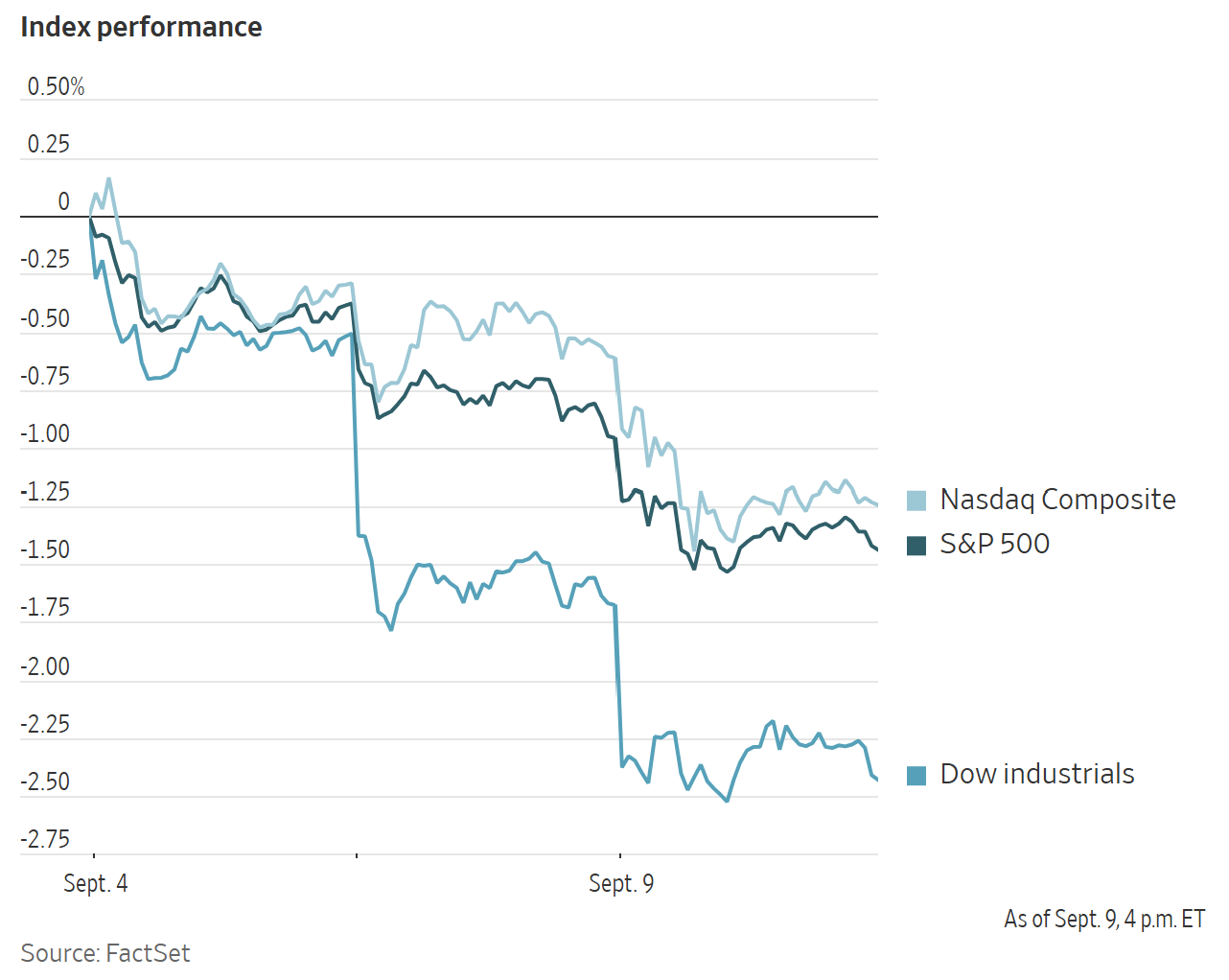
US equity indexes declined on Wednesday, extending losses for a third consecutive session. The Nasdaq Composite was -0.64%, or down 168.07 points, to 26,253.34. The S&P 500 fell -0.48%, or down 37.16 points, to 7,636.36. The Dow Jones Industrial Average was -0.77%, or down 405.41 points, to 52,380.66.
In corporate news, Apple announced the iPhone Duo, positioning the iPhone as the company’s primary AI device. The product event included the launch of the foldable iPhone Duo, which is expected to start at $1,999, broadly in line with market expectations. Apple also introduced the iPhone 18 Pro Max at $1,299 and the iPhone Pro at $1,199, with both models priced $100 above iPhone 17 levels, as anticipated. Lower-priced models are expected to be delayed until next spring. This could support product mix and average selling prices and potentially prompt some demand deferral among more price-sensitive buyers.
Alphabet’s Google is investing €13 billion in AI infrastructure in Finland, marking its largest European investment to date. The Nordic country’s cold climate and carbon-free power supply have made it an attractive location for data-centre development.
Amazon raised £4.25 billion through its debut sterling bond sale, increasing the size of the four-part transaction despite a decline in investor orders.
Dell Technologies raised $5 billion in an investment-grade bond sale that attracted strong investor demand, supported by the company’s revenue momentum from AI servers.
According to Bloomberg news, Dow is considering exiting its $20 billion chemicals partnership with Saudi Aramco. The potential move forms part of the US company’s efforts to reshape its portfolio amid a prolonged industry downturn.
Corporate Earnings Reports
Posted on Wednesday, 9 September from The Pulse, our real-time AI-driven news tool. Available exclusively on the EXANTE Web Platform
Chewy reported Q2 results. Revenue was $3.33bn vs $3.32bn expected, up +7.3% y/y. Adjusted EPS was $0.36, up +9.1% y/y. Adjusted EBITDA was $226.7mn vs $211mn expected, up +23.7% y/y, with margin of 6.8% vs 6.5% expected. Free cash flow was $89.5mn vs $133mn expected, down -15.5% y/y. Active customers grew +3.8% y/y to 21.705mn. The company raised its full-year revenue and profitability outlook. CEO Sumit Singh said the durability of the recurring revenue base, continued customer growth, and disciplined execution gave confidence to raise the full-year outlook.
Signet Jewelers reported Q2 FY27 results before the open. Revenue came in at $1.5bn, flat y/y and slightly below the $1.53bn consensus. Adjusted EPS of $2.19 beat estimates of $1.74, rising +36% y/y, while adjusted operating income of $107.2mn exceeded the $89.7mn forecast, up +26% y/y. Same-store sales grew +2.2%. For FY27, the company raised its adjusted EPS guidance to $10.45-$12.15 from $9.20-$11.00 and lifted its adjusted operating income and EBITDA ranges, while keeping revenue guidance unchanged. CEO commented, 'we are raising our full year adjusted EPS guidance by over 10%' and noted 'operating margin expansion reflecting comp growth and spend discipline.'
Academy Sports & Outdoors reported Q2 fiscal 2026 earnings. Revenue was $1.65bn, in line with estimates, up +3% y/y. Adjusted EPS was $2.31 vs $2.08 expected, up +19.1% y/y. Adjusted net income was $146.5mn vs $136mn expected, up +11.6% y/y. Comparable sales fell -0.4%. For FY26, revenue guidance of $6.23bn-$6.36bn was affirmed, adjusted EPS guidance was raised to $6.50-$6.90 from $6.40-$6.80. Gross margin was 40.4% and eCommerce sales rose +12.8%. The CEO said that while consumer spending remains pressured, the company is reinvesting tariff-related benefits into value and expanding brands and categories.
American Eagle Outfitters reported Q2 FY26 results after the close. Revenue was $1.38bn, +8% y/y and above the $1.37bn estimate. EPS of $0.79, up +76% y/y, significantly beat the $0.22 consensus. Total comparable sales rose +6%, with Aerie up +19% but American Eagle down -1%. Gross margin expanded +980bps to 48.7%, partly due to a $161mn tariff refund benefit. FY26 guidance saw operating income of $540mn-$550mn (est. $398mn), while Q3 operating income guidance of $110mn-$115mn missed the $124mn estimate. CEO Jay Schottenstein commented that the quarter reflected the value of the AEO Inc. portfolio, led by momentum at Aerie and OFFLINE alongside progress at American Eagle.
AeroVironment reported Q1 FY27 results. Revenue was $480.5mn vs $456mn expected, up +6% y/y. Adjusted EPS was $0.59 vs $0.25 expected, up +84% y/y. Funded backlog reached $1.5bn, up +37% y/y. The company affirmed its full-year FY27 guidance for revenue of $2.1bn-$2.2bn and adjusted EPS of $3.02-$3.34. CEO cited "record first-quarter revenue and funded backlog and landmark strategic wins" and noted the priority is expanding manufacturing capacity and strengthening the supply chain.
European Stock Indices
CAC 40 -1.94%
DAX -1.66%
FTSE 100 -1.31%
Commodities
Gold spot +1.06% to $4,400.49 an ounce
Silver spot +2.31% to $67.27 an ounce
West Texas Intermediate +3.18% to $97.04 a barrel
Brent crude +2.58% to $101.63 a barrel
Gold advanced on Wednesday, supported by continued pressure on the US dollar.
Spot gold rose +1.06% to $4,400.49 per ounce. The US dollar remained near a two-week low, making dollar-denominated gold less expensive for holders of other currencies.
Spot silver gained +2.31% to $67.27 per ounce.
Brent crude futures breached $100 per barrel on Wednesday after Iran and the US struck tankers in the largest wave of shipping attacks since the war began, heightening concerns over further disruption to Middle East energy supplies.
Front-month Brent crude futures settled $2.56, or +2.58%, at $101.63 per barrel, while US WTI crude rose $2.99, or +3.18%, to $97.04 per barrel. Both benchmarks closed at their highest levels since 22 May.
Futures prices continued to converge with physical crude and refined-product markets, where supply tightness has been evident for much of the conflict.
The latest attacks renewed concerns over transit through the Strait of Hormuz. Preliminary Kpler shipping data showed that six commodity vessels passed through the strait on Tuesday, down from nine the previous day and below the 10-day average of roughly 12 vessels.
In the week before fighting resumed on 30 August, approximately 8 - 9 million bpd flowed through the strait, double the prior week’s volume. This week, flows have fallen below 2 million bpd.
Port officials said a tanker carrying about 2 million barrels of Iraqi fuel oil was struck by a drone in Iraqi territorial waters on Wednesday. UKMTO, a British navy-linked agency, reported that several merchant vessels in the Gulf had been hit by disabling fire overnight.
Peninsula, the charterer of the Gibraltar-flagged oil products tanker Hercules Star, said on Wednesday that a seafarer was killed in an incident while the vessel was at anchorage off Dubai.
The escalating conflict in Yemen also intensified concerns over a broader regional war and further Red Sea disruption. The deteriorating security situation drew attention after the Saudi-led coalition carried out airstrikes against Iran-aligned Houthi militants, according to the AP. Local media also reported that Yemen’s Saudi-backed defence minister had fled, while Pakistan was considering joining the conflict against the Houthis at Saudi Arabia’s request.
These developments followed a wave of Houthi attacks on Saudi oil facilities and reinforced concerns that Yemen could become another front in the Iran war. Fighting now threatens traffic through Bab el-Mandeb, potentially worsening Red Sea disruption alongside the already severely constrained Strait of Hormuz.
The EIA Short-Term Energy Outlook pointed to a tightening global diesel market, adjusted 2026/2027 global supply and demand estimates by no more than 200,000 bpd. It placed total cumulative DUCs at record lows based on more than 12 years of data.
China’s oil demand is expected to decline by 600,000 bpd in 2026, or -8.9% y/o/y, marking a third consecutive annual contraction as elevated oil prices constrain consumption and electric-vehicle adoption accelerates, according to Sinopec’s research arm.
Note: As of 4 pm EDT 9 September 2026
Currencies
EUR +0.09% to $1.1634
GBP +0.10% to $1.3546
Bitcoin -0.47% to $78,140.95
Ethereum -0.89% to $2,461.83
The US dollar traded near a seven-month low against the yen on Wednesday as investors positioned ahead of next week’s central bank meetings.
The dollar has come under pressure from the yen’s sharp appreciation over the past week and from shifting expectations ahead of policy decisions by the Fed and BoJ.
The dollar was -0.08% at ¥153.56, remaining close to Tuesday’s seven-month low of ¥152.89.
The dollar pared losses against major peers after the US Treasury Department said it would triple the size of its long-dated buyback operation on Thursday, purchasing up to $6 billion in bonds.
The dollar index was -0.08% at 98.78, approaching its lowest level in nearly two weeks.
The euro rose +0.09% to $1.1634, nearing a two-week high ahead of a widely expected ECB rate increase today.
The yen remained in focus after gaining +3.86% so far this month against the dollar, creating a challenge to the carry trade.
The Japanese currency has also strengthened broadly against the euro and sterling, as well as against popular carry-trade currencies such as the Mexican peso and Turkish lira.
The gains have been driven by expectations of faster BoJ policy tightening, the prospect of repatriation flows from Japanese investors and pressure from Washington for a stronger yen.
Markets broadly expect the BoJ to raise interest rates by 25 bps at its 17 - 18 September meeting. Further yen appreciation will depend on any hawkish signals from BoJ Governor Kazuo Ueda.
Fixed Income
US 10-year Treasury +5.1 basis points to 4.849%
German 10-year Bund +9.9 basis points to 3.459%
UK 10-year Gilt +9.3 basis points to 5.199%
10-year Treasury yields reached their highest levels since November 2023 on Wednesday after the announcement of an enlarged US Treasury buyback of longer-dated bonds.
Yields retreated from their highs, however, after the Treasury saw very strong demand for a $39 billion sale of 10-year notes.
The Treasury Department sold the 10-year notes at a high yield of 4.834%, more than a basis point below where they traded ahead of the auction. The bid-to-cover ratio was 2.71x, the highest since 2019.
The US government already saw solid demand for its $58 billion sale of 3-year notes on Tuesday and will also sell $22 billion in 30-year bonds on Thursday.
The yield on US 10-year notes was up +5.1 bps at 4.849% after earlier reaching 4.857%.
The 30-year bond yield rose +4.5 bps to 5.293% after touching its highest level since 18 August. The 2-year note yield, which typically moves in step with Fed funds rate expectations, rose +5.1 bps to 4.445%, its highest level since July 2024.
The US 2s10s yield curve stood at 40.4 bps.
US producer price and consumer price inflation reports are due to be released today and tomorrow, respectively. These may give investors further signals of future Fed policy.
Fed funds futures traders are now pricing in 60.2% odds of a rate hike next week, from 59.4% the prior session.
Eurozone government bond yields reached fresh multi-year highs on Wednesday as traders priced in two interest rate hikes in 2026, leading to an ECB deposit rate of 2.75% by the end of this year and a 3.1% rate by late 2027.
The ECB, which raised rates in June, is widely expected to tighten its policy again today, while reiterating its data-dependent stance as the Iran war drags on.
Germany's 10-year bond yield reached 3.459%, its highest level since 2011, up +9.9 bps on the day.
German two-year bond yields, more sensitive to policy rates, were up +10.1 bps to 3.081%, near a more than two-year high.
The ECB began tightening relatively early, and the combination of higher bond yields and elevated energy costs could weigh on European growth in the near term, giving policymakers scope to remain on hold.
Italy's 10-year government bond yields rose +7.7 bps to 4.277%, leaving the spread over Bunds at 81.8 bps.
France's 10-year OAT yields hit a fresh 18-year high at 4.330%, up +11.0 bps, as concerns about the country's fiscal trajectory weighed on sentiment.
Note: As of 4 pm EDT 9 September 2026
While every effort has been made to verify the accuracy of this information, EXT Ltd. (hereafter known as “EXANTE”) cannot accept any responsibility or liability for reliance by any person on this publication or any of the information, opinions, or conclusions contained in this publication. The findings and views expressed in this publication do not necessarily reflect the views of EXANTE. Any action taken upon the information contained in this publication is strictly at your own risk. EXANTE will not be liable for any loss or damage in connection with this publication.
Ten artykuł jest publikowany wyłącznie w celach informacyjnych i nie powinien być traktowany jako oferta lub zachęta do kupna lub sprzedaży jakichkolwiek inwestycji lub powiązanych usług, do których można się tu odwołać. Obrót instrumentami finansowymi wiąże się ze znacznym ryzykiem strat i może nie być odpowiedni dla wszystkich inwestorów. Wyniki osiągnięte w przeszłości nie są wiarygodnym wskaźnikiem wyników w przyszłości.
 Wróć do wszystkich informacji




Zarejestruj się i otrzymuj informacje rynkowe
Zarejestruj się i otrzymuj
informacje
rynkowe
Subskrybuj teraz Subskrybuj teraz


Stworzone przez profesjonalistów. Dla profesjonalistów.
